Start with the question you need to answer. A rapid water reaction, visual clarity assessment and microbial-growth slide examine different aspects of a fuel sample. Choosing by result speed alone can leave the original question unanswered.
Choose the fuel-compatible method
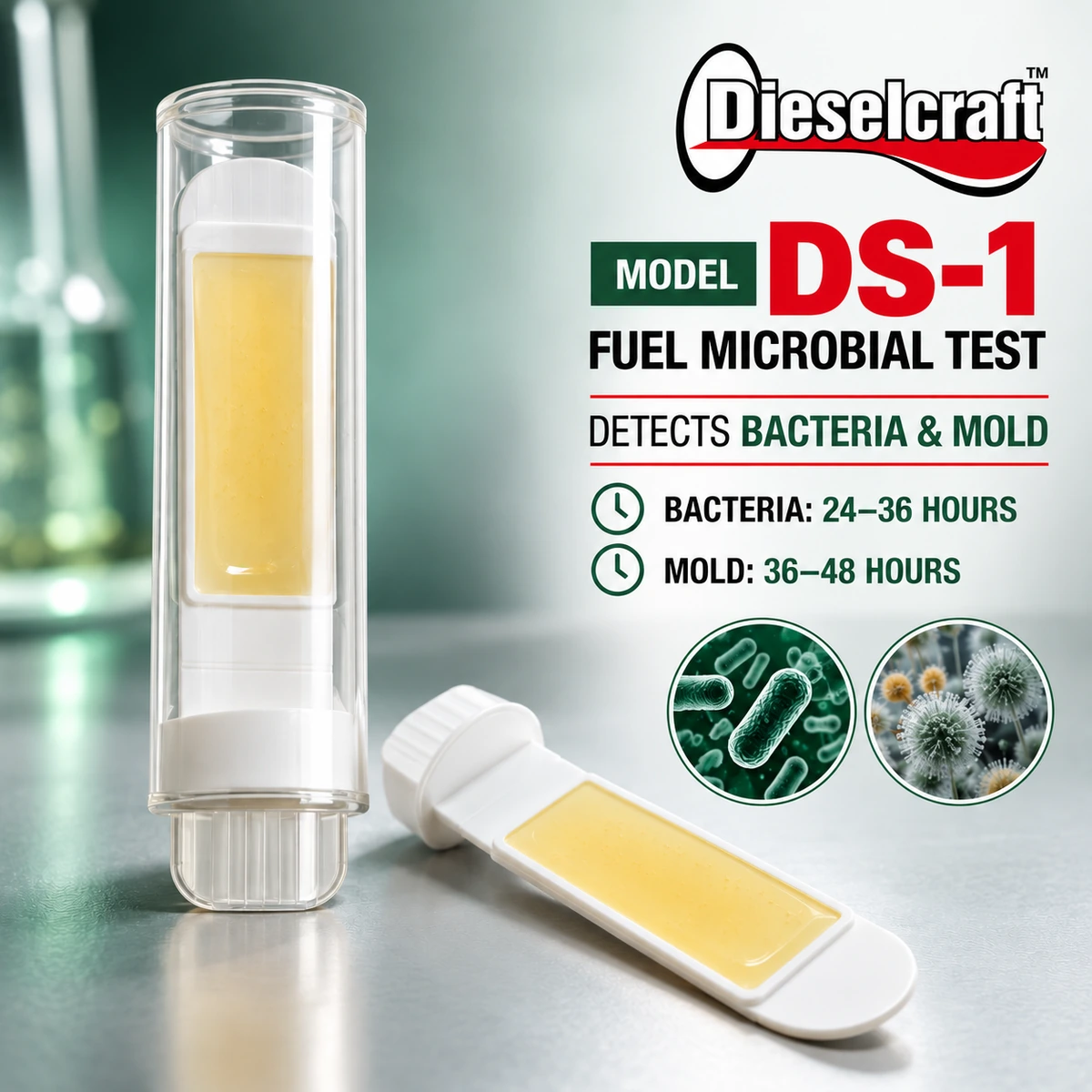
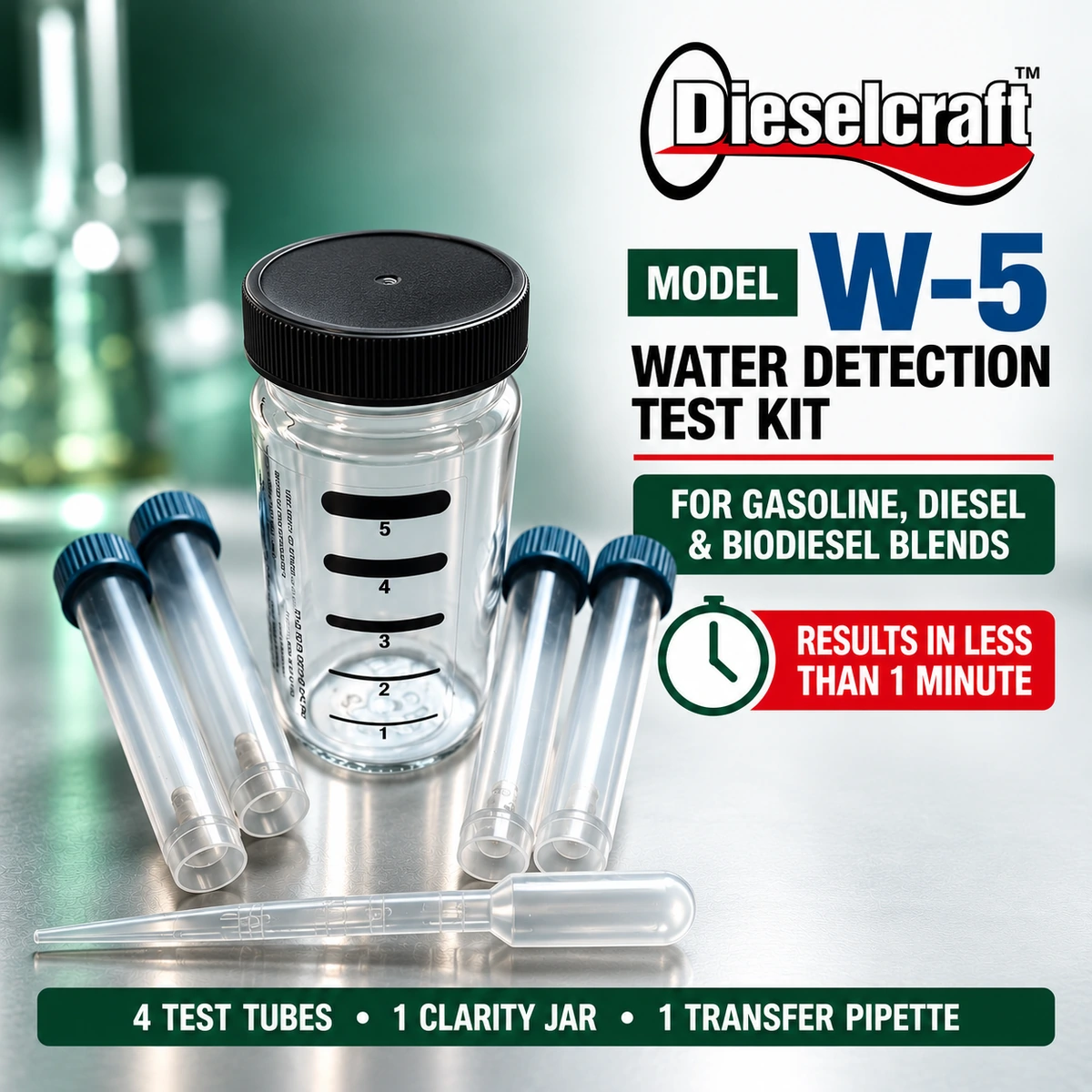
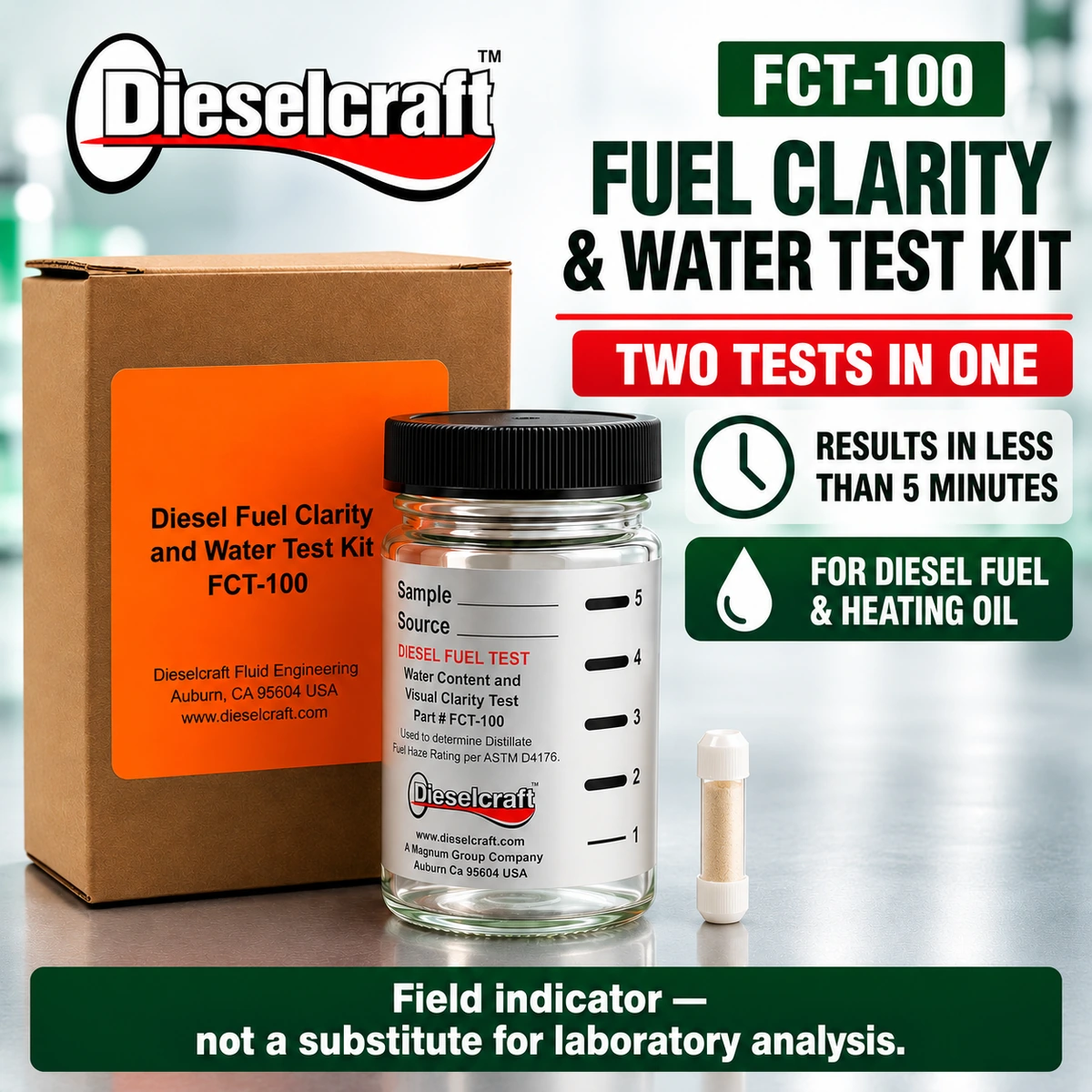
DS-1 is for diesel only. FCT-100 is for diesel and heating oil. W-5’s supplied instructions cover gasoline, diesel and biodiesel blends. Do not apply another model’s compatibility or reading scale to your kit.
Choose the question
For a rapid water-focused check, consider W-5. For diesel/heating-oil clarity and a follow-up suspended-water reaction, consider FCT-100. For suspected bacteria or mold in diesel, use DS-1 and allow its stated reading time. Dieselcraft recommends pairing DS-1 with a water/clarity check when investigating contamination.
Plan samples and quantities
Record the date and sample location; FCT-100 specifically provides for marking the jar. DS-1 and FCT-100 recommend bottom-of-tank sampling when possible. W-5 allows sampling from multiple locations. Different locations and later retests require their own sample and reagent allocation. DS-1 has one single-use slide; W-5 supplies five water-test capsules; FCT-100’s two stages assess a sample using the supplied capsule. “Two tests” describes two checks, not automatically two sample allocations.
A practical sampling checklist
Use this planning checklist alongside your site procedures and the selected kit’s official instructions. It is a recordkeeping aid, not a universal sampling standard.
- Define the question: water, clarity/solids, microbial growth, or a combination.
- Identify each sampling point: assign a tank or equipment ID and describe the location. Use an accessible bottom sample for DS-1 or FCT-100 when possible; W-5 permits samples from multiple locations. Follow your site’s approved access and sampling procedure.
- Label each sample: record date, time, tank/equipment ID, sampling point and fuel type. Mark the FCT-100 jar with its date and source as instructed.
- Plan initial checks and retests separately: a different sampling point or a later follow-up consumes its own slide or reagent allocation. Do not combine samples when your question requires a result for each location.
- Keep the test conditions consistent: use the chosen model’s instructions and reading time. Do not touch DS-1 test surfaces or open water-test capsules before you are ready.
- Prepare a results record: note the test model, observed result, reading time and next action. Include a photograph if useful.
Worked quantity example: three locations, two rounds
Illustrative planning example: three separate sampling points, one initial round and one post-maintenance round = 6 sample checks for each chosen method. This is not a recommended fixed testing frequency.
- DS-1: 6 single-use slide tests require 6 DS-1 kits.
- W-5: 6 water checks require 6 capsules. With five supplied capsules per kit, plan 2 W-5 kits, leaving 4 unused capsules if all supplied capsules are available.
- FCT-100: plan 6 sample assessments and the corresponding water-stage reagent allocations when those stages are performed. Confirm the supplied sale-pack quantity before ordering; “two tests in one” does not mean two independent samples.
Using DS-1 and a water/clarity method at the same sampling point requires allocations for both methods. Reusing an empty container does not replenish a consumed slide or capsule.
DS-1: run the microbial-growth check
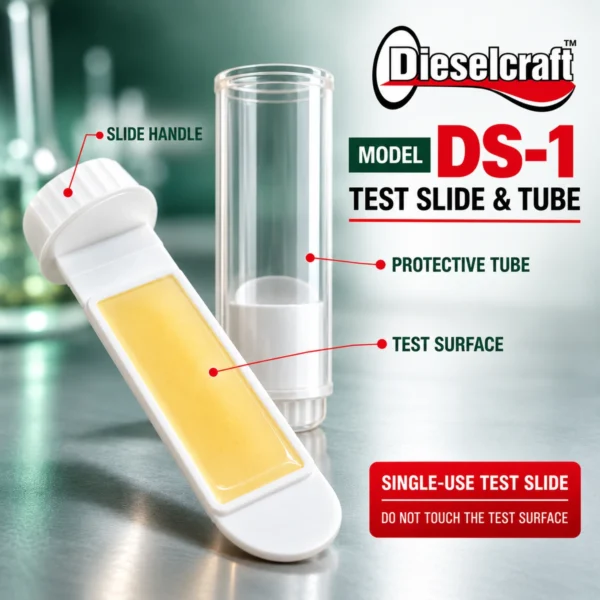
- Remove the slide from its tube without touching either test surface.
- Dip it into the diesel sample for 30 seconds. Use a bottom-of-tank sample when accessible.
- Shake off excess fuel and return the slide to the tube.
- Keep it in a dark, warm location as instructed.
- Inspect at 24, 36 and 48 hours.
- Clear side — bacteria: read at 24–36 hours. Spots or discoloration indicate bacterial presence.
- Dark side — mold: read at 36–48 hours. Spots, fuzz or a colour change indicate growth.
- No growth seen: no growth was detected under the test conditions at those reading intervals. This does not establish that the fuel is free of water, solids or other contamination.
After a positive result: investigate water, assess water removal and fuel polishing, then decide on treatment. Do not automatically add biocide. Do not reuse the slide. For disposal, consult the manufacturer’s instructions and applicable site waste procedures. Read the official DS-1 instructions and interpretation guide.
W-5: understand the rapid water check
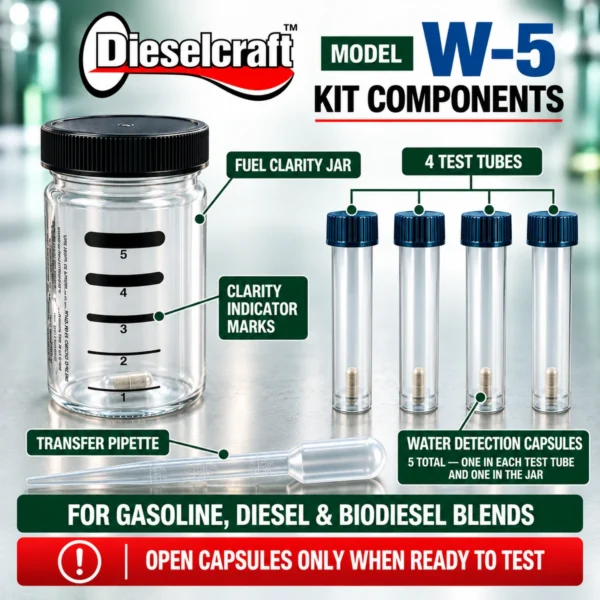
W-5 checks for free and suspended water in gasoline, diesel and biodiesel blends. The stated result time is less than one minute. It is a qualitative PASS/FAIL check, not a precise dissolved-water measurement.
- Remove the capsule before adding fuel; do not pour fuel onto it.
- Open the capsule only when ready to test. Moisture from the air can affect the reading.
- Follow the supplied PDF for the selected container, sample transfer and powder placement. The procedure includes an approximately three-quarter fill and a 5-second shake.
- Let the mixture settle and inspect the powder colour at the bottom.
- Use the W-5 instructions for visual clarity inspection and the specific reading method for red-dyed diesel.
Pink indicates a water reaction. Investigate a failed water check. A white result does not prove absolutely zero water. Do not apply FCT-100’s numerical colour bands to W-5; fuel blend affects detection. Each water check consumes one capsule. Use the official W-5 PDF as the operating reference.
FCT-100: clarity first, then suspended water
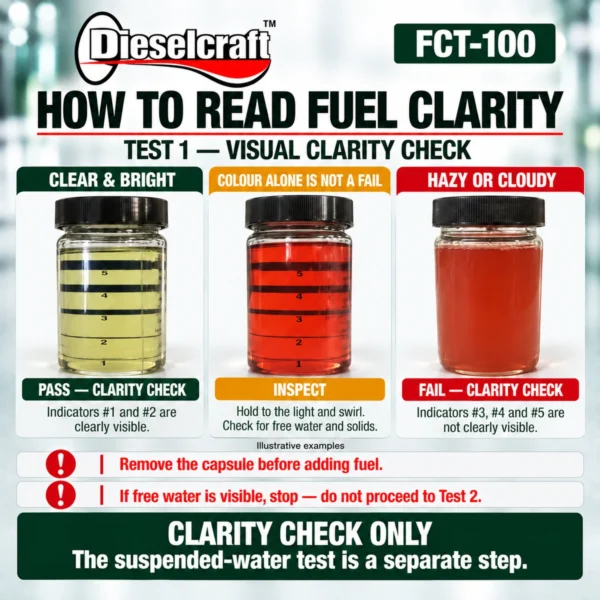
Before starting
Remove the capsule and keep it aside for the water stage. Do not pour fuel onto it or open it early. Use this kit for diesel and heating oil. Its stated overall result time is less than five minutes.
Stage 1 — clarity and visible contamination
- Take a bottom-of-tank sample when possible and fill past indicator rectangle #5.
- Hold the jar to the light. Look for haze, swirl to form a vortex, and inspect for free water and solids.
- If free water is visible, stop: the sample has failed. Skip Stage 2.
- Clear, bright fuel with rectangles #1 and #2 clearly visible passes the clarity check. Cloudiness obscuring #3, #4 and #5 fails it.
Stage 2 — suspended-water reaction
- Run this stage only if the first stage did not already fail on visible free water.
- Open the capsule, add its powder to the jar, close the lid and shake for 10 seconds.
- Hold upright, allow the powder to settle and compare the bottom colour with the FCT-100 scale.
- White: low or no suspended water at the detection level of this kit; not proof of absolute absence.
- Pink spots: the manufacturer’s 10–49 ppm indication band; investigate the tank and plan maintenance.
- Hot pink throughout: the manufacturer’s 50+ ppm indication band; action is required to address water and fuel condition.
These are FCT-100 field indication bands, not a precise laboratory concentration or a universal fuel-acceptance limit. A failed check supports investigation and assessment of water removal/polishing. Read the official FCT-100 procedure and colour scale.
Record the result and the next decision
For each check, record:
- Sample ID, date/time, fuel type and sampling point.
- Kit model and the slide/capsule used.
- Start time, reading time and observed result; for DS-1, record the clear and dark surfaces separately.
- A photograph of the result where helpful.
- The investigation or maintenance decision, the person responsible and the planned verification check.
Three practical result scenarios
- W-5 turns pink: record the water reaction and investigate the source. It does not identify microbes; add a compatible microbial check if that is part of the investigation.
- FCT-100 shows visible free water: stop before the powder stage, record the failure and assess corrective work. Recheck an appropriately collected sample after that work.
- DS-1 shows growth: record the side and reading time, investigate water and assess removal/polishing before treatment. Avoid choosing a treatment dose from the slide result alone.
A negative result in one method does not cancel a positive result in another: the methods answer different questions.
Use findings to investigate the cause
A positive microbial result should lead to an investigation of water. Dieselcraft advises addressing water and considering polishing before deciding on treatment, rather than adding biocide automatically. A failed clarity or water check is a reason to investigate and plan corrective work, not a complete sizing specification for a polishing system. Selecting treatment equipment also needs information about the tank, fuel volume, contamination and operating arrangement.
Choose testing occasions through a maintenance plan
Useful planning points include delivery, return to use after storage, suspected contamination and verification after corrective work. These are planning examples; the supplied product PDFs do not prescribe a universal interval. Follow equipment requirements and applicable site procedures.
Know when field screening is insufficient
FCT-100 states that it is a general indicator, not a substitute for laboratory analysis. Questions about precise water concentration, fuel composition or formal fuel acceptance need an appropriate analytical method. A field PASS answers the selected field test, not every possible fuel-quality question.
Compare the products
View DS-1 · View W-5 · View FCT-100
Related fuel solutions
Fuel Testing · Fuel Purification · Fuel Polishing
Official Dieselcraft references
DS-1 Fuel Test Kit — Official Product Sheet