

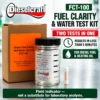
Clarity and water assessment in two stages
Assess a diesel or heating-oil sample visually, then run the suspended-water reaction when appropriate. The clarity check is based on ASTM D4176.
Specifications and sample capacity
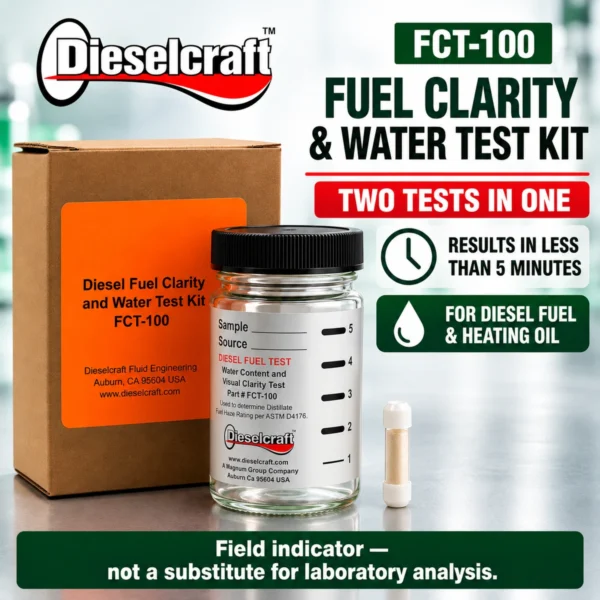
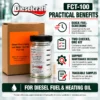
- Sample assessment: clarity + water stages on the same sample, using the supplied water-test capsule. “Two tests in one” means two types of check, not two independent sample tests.
- Result time: less than 5 minutes.
- Compatible fuels: diesel fuel and heating oil.
- Result: field PASS/FAIL indication; not a substitute for laboratory analysis.
Before you start
Remove the capsule and set it aside before adding fuel. Open it only when ready to use; air moisture can cause a false reading. Mark the date and sample source on the jar. Do not put the capsule in your mouth.
Stage 1 — Fuel clarity
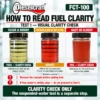
- Take a bottom-of-tank sample when possible. Fill above indicator rectangle #5.
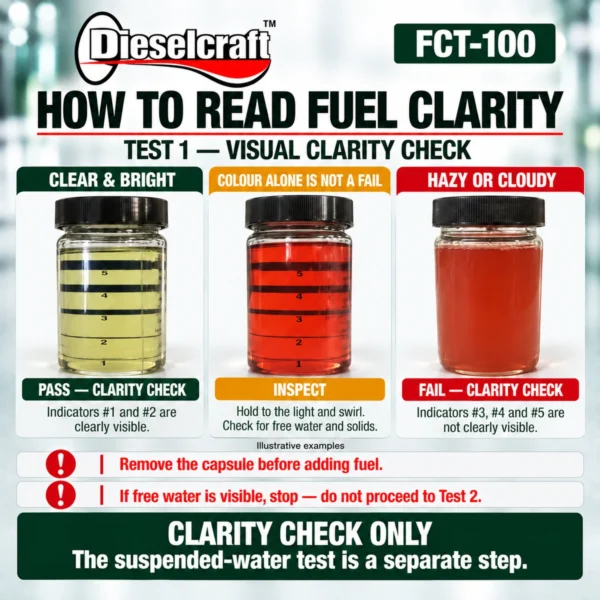
- Hold to the light, inspect for haze, swirl and check for free water or solids.
- If free water is visible, stop: the sample has failed; skip Stage 2.
PASS: clear, bright fuel with rectangles #1 and #2 clearly visible. FAIL: cloudy fuel with rectangles #3, #4 and #5 not clearly visible. Investigate the tank and plan corrective maintenance.
Stage 2 — Suspended water
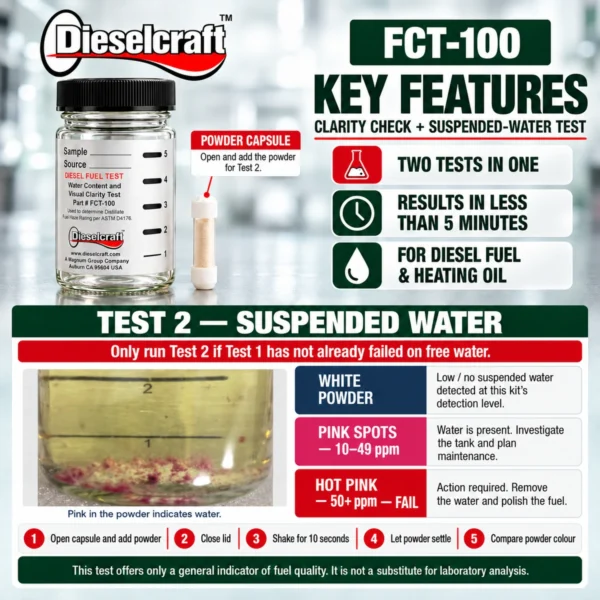
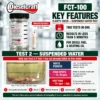
Only run this stage if Stage 1 did not already fail on free water. Open the capsule, add the powder, close the lid and shake for 10 seconds. Let the powder settle and compare its colour with the manufacturer’s scale.
- White: low/no suspended water at the detection level of this kit.
- Pink spots: the source’s 10–49 ppm indication band; water is present and requires investigation.
- Hot pink: the source’s 50+ ppm indication band; action is required.
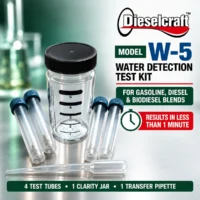
These are field indication bands, not a precise laboratory concentration. Do not apply this scale to W-5.
How many tests does one kit provide?
The supplied procedure assesses a sample in two stages, with a capsule consumed in the water stage. Two stages do not mean two independent sample tests. Allow separate samples and reagent allocation for additional locations or retests; ask ANKORZ to confirm the supplied pack contents when planning your quantity.
What happens next?
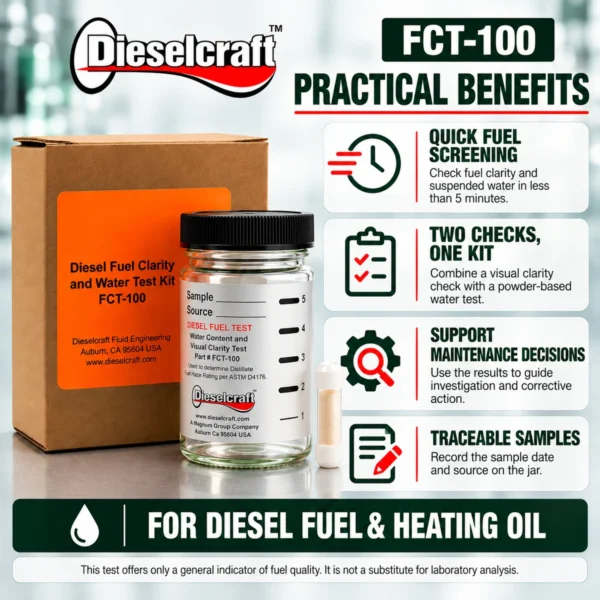
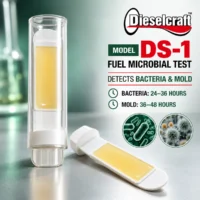
A failed check supports investigation of water and solids and assessment of appropriate maintenance or polishing. Pair with DS-1 when investigating microbial growth in diesel. This field indicator does not certify every aspect of fuel quality.

Reviews
There are no reviews yet.