Fuel Polishing Solutions

Fuel Polishing Solutions

Recirculating diesel fuel polishing for clean, reliable fuel in storage tanks, generators, boats and fleets

Designed For Technical Professionals

Our fuel polishing solutions serve engineers and operators who store and move diesel — from standby generators and marine vessels to industrial sites and fleet fuel storage — with Dieselcraft systems for portable and stationary tank cleaning.

Marine operators & ship owners

Power plants & generator operators

Industrial facilities

Fleet & fuel storage operators

Maintenance and reliability engineers

Why Fuel Polishing Matters

Water, sediment and microbial growth (diesel bug) can build up in stored diesel and reach filters and engines.

Water and sediment reaching the engine

Microbial growth (diesel bug) in fuel systems

Premature filter clogging

Injector and fuel pump wear

Engine downtime and unexpected failures

ANKORZ Solution Overview

ANKORZ supplies Dieselcraft fuel polishing systems that recirculate and filter diesel through a filterless purifier and 10-micron filtration.

Removes over 99% of water

10-micron final filtration

Filterless primary purifier — no element to replace

Models from 420 GPH to 1,200+ GPH

How a Fuel Polishing System Works

Each Dieselcraft system draws fuel through staged separation and filtration, then returns it to the tank or transfers it.

Fuel Is Drawn from the Tank

A pump draws diesel from the tank through anti-static hoses with cam-lock fittings.

1

Primary Separation

A Dieselcraft filterless purifier separates free water and heavy contamination without a replaceable filter element.

2

10-Micron Filtration

Spin-on filters provide final filtration to 10 microns; change-indicator gauges show when to service them (model dependent).

3

Magnetic Fuel Conditioning

The FPS-400, FPS-30 and FPS-400S include a magnetic fuel conditioner to help fight bacteria growth.

4

Monitoring

Digital flow meters, water/debris alarms and filter gauges show flow and service points (model dependent).

5

Polished Fuel Returns or Transfers

Cleaned fuel is recirculated to the tank or transferred, depending on the job.

6

Fuel Polishing Systems

Modular diesel fuel polishing systems for tank cleaning — from the compact FPS-HC15 to the 1,200+ GPH FPS-30 and the stationary FPS-400S.
Dieselcraft FPS-HC15 compact diesel fuel polishing system - main view

FPS-HC15 – Compact Diesel Fuel Polishing System

Purpose:
Compact fuel polishing system that transfers and polishes diesel in storage tanks, boats, generators and trucks — filterless 5x16 purifier with 10-micron final filtration.
When to Use:

Case of 12 filters included

Dieselcraft FPS-400 diesel fuel polishing system - main view

FPS-400 – Diesel Fuel Polishing System

Purpose:
Modular tank cleaning and polishing system for transferring and recirculating diesel in boats, generators and trucks, with a filterless 5x24 purifier.
When to Use:

12 spin-on filters included

Dieselcraft FPS-30 stainless steel fuel polishing system - main view

FPS-30 – Stainless Steel Fuel Polishing System

Purpose:
Stainless-steel polishing system for larger storage tanks, boats and generators — over 1,200 GPH with a filterless 8x32 purifier and dual 10-micron filters.
When to Use:

6 filters included — dual change-indicator gauges

Dieselcraft FPS-400S stationary fuel polishing system - main view

FPS-400S – Stationary Fuel Polishing System with Fire-Resistant Hose

Purpose:
Stationary polishing system for diesel storage tanks, with a filterless 5x24 purifier and fire-resistant Flehtral GH-16 hose.
When to Use:

12 spin-on filters included

How to choose the right fuel polishing system

Start with the job size and duty, then compare the four systems against your tank volume and site power.
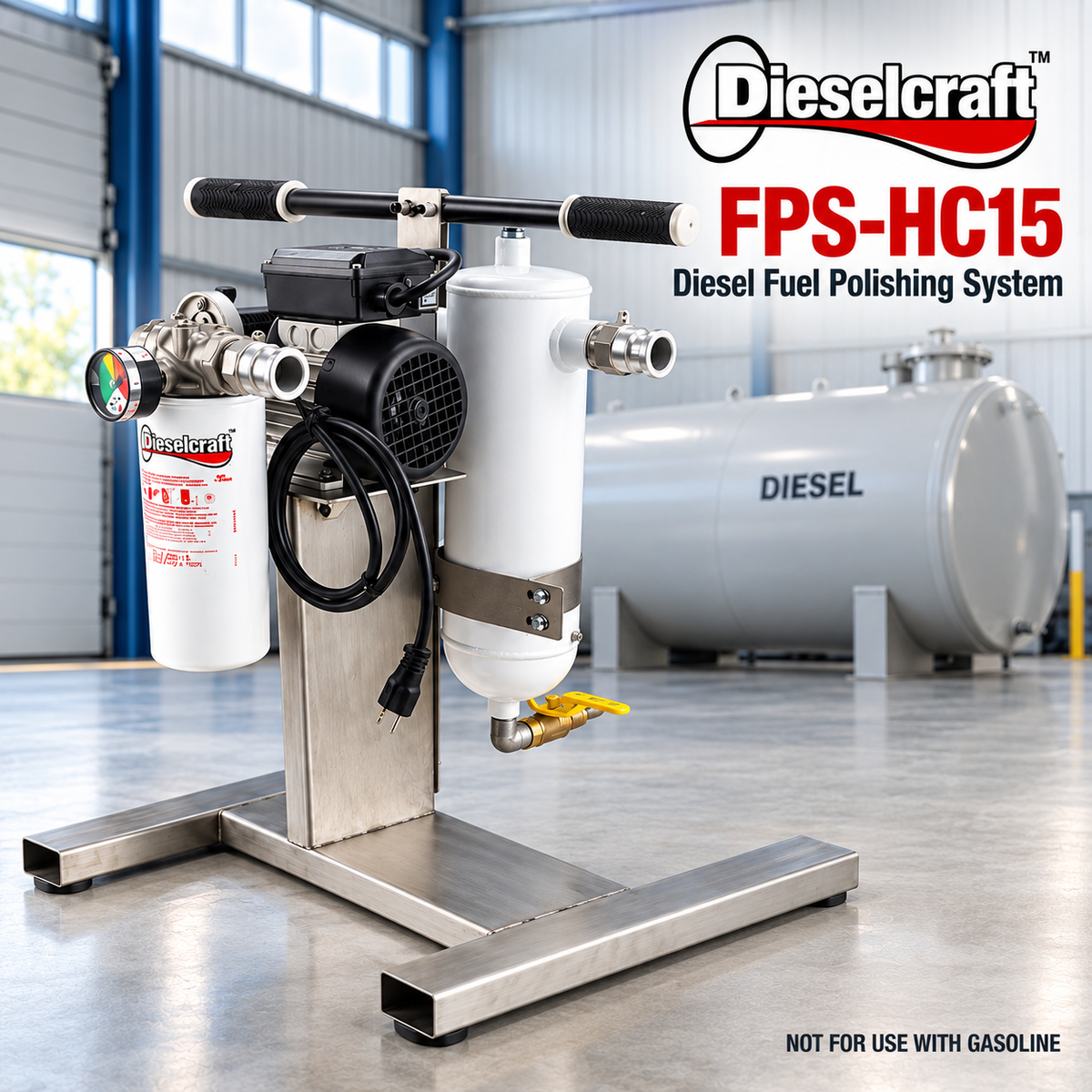
Dieselcraft FPS-HC15 fuel polishing system

FPS-HC15

Need a compact, portable system

Compare the FPS-HC15 with your job size, weight limits and available power. Confirm against the current model data sheet.
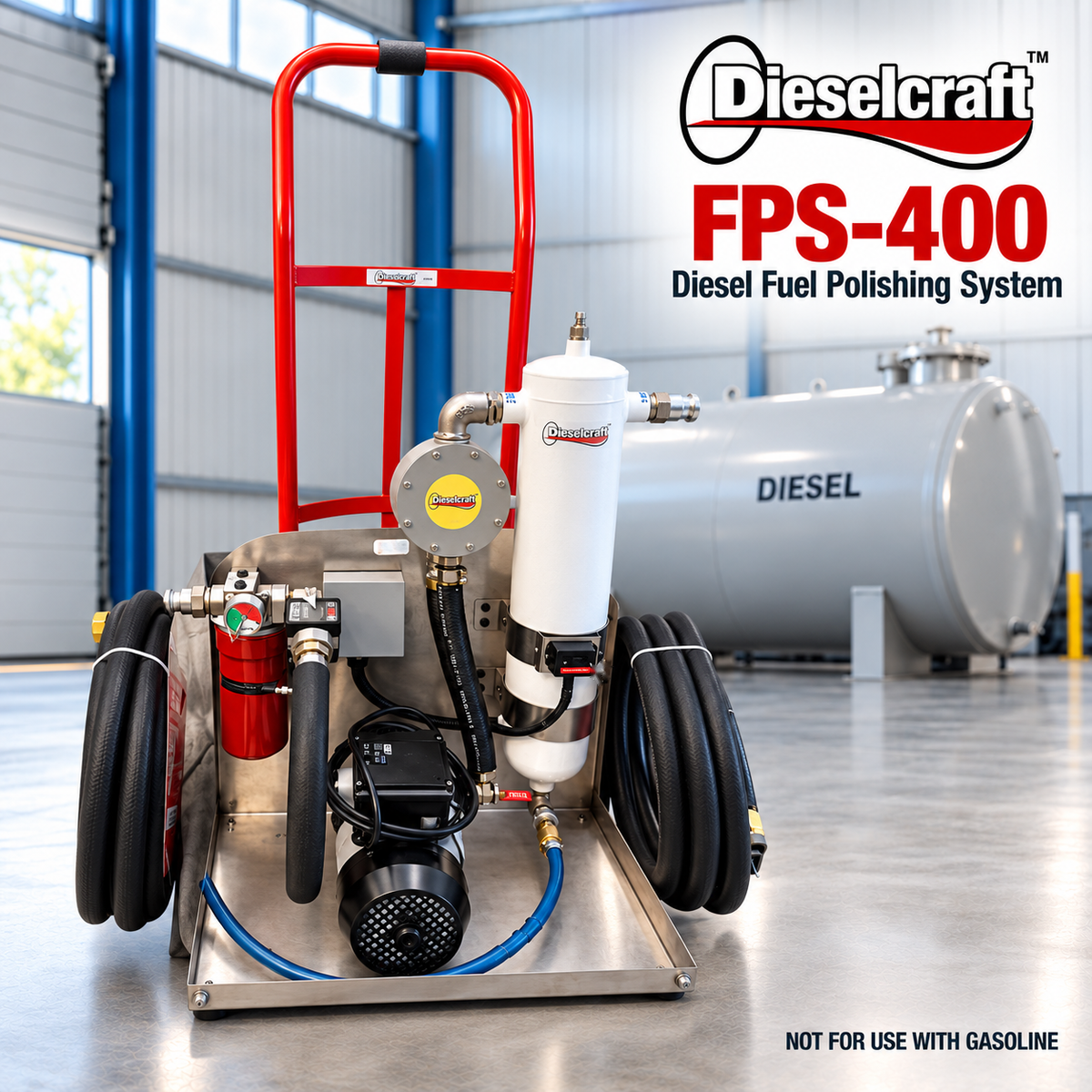
Dieselcraft FPS-400 fuel polishing system

FPS-400

Polishing 50 to 1,200 gallons

Include the FPS-400 for intermediate tank jobs. Match its flow with your tank volume and hose reach.
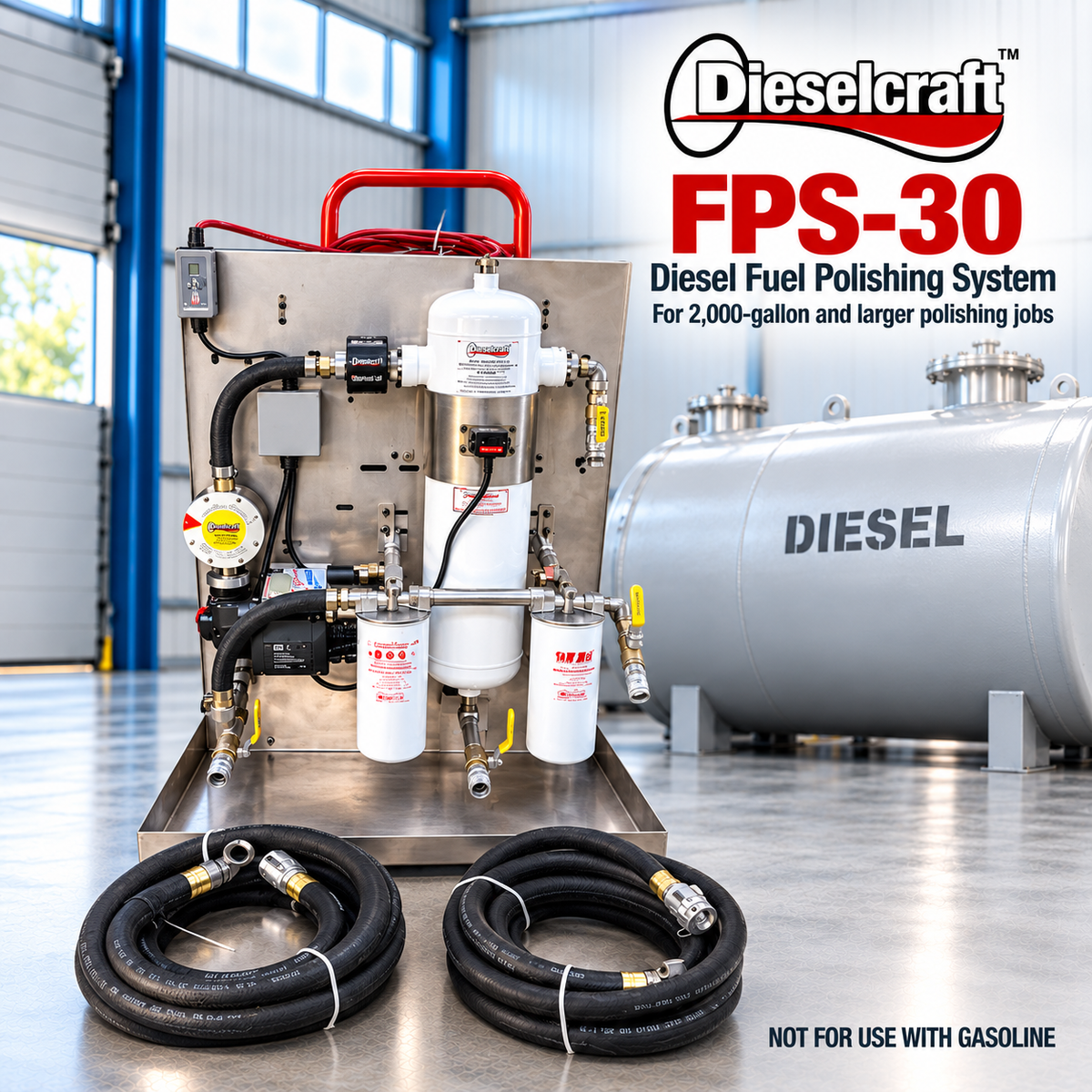
Dieselcraft FPS-30 fuel polishing system

FPS-30

Planning a 2,000-gallon-plus job

Compare the FPS-30 for larger tanks needing over 1,200 GPH, and review the optional pre-filter and digital timer.
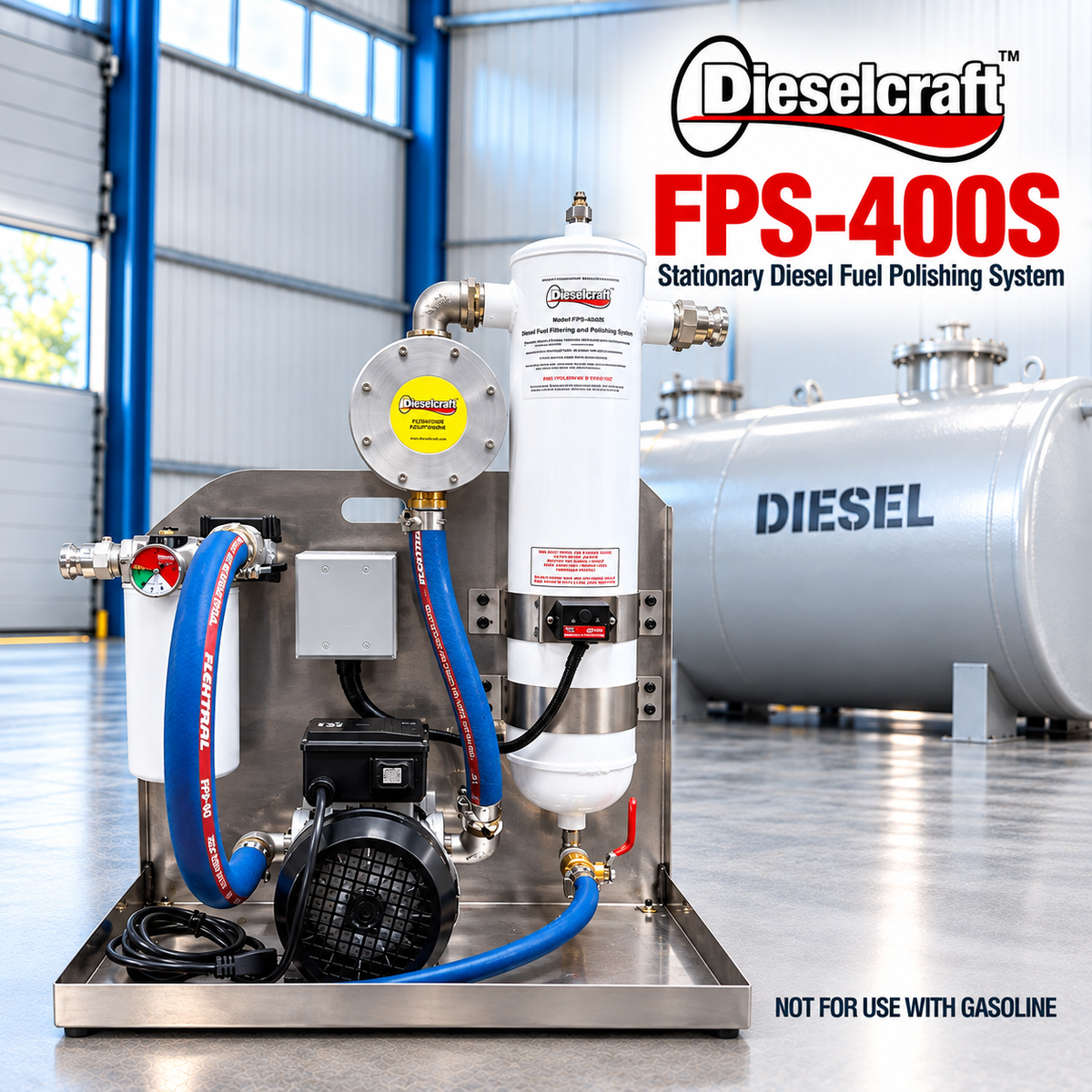
Dieselcraft FPS-400S fuel polishing system

FPS-400S

Fixing a system to a storage tank

Consider the FPS-400S for stationary tank installations that need a fire-resistant hose.

When should you assess fuel polishing?

Consider polishing for diesel that sits in storage tanks, boats and standby generators, or when you see water, sediment or filter clogging. Test the fuel first, then decide between polishing and replacement based on the results.

A clear selection workflow

  1. Define the tank size, fuel type and contamination condition.
  2. Test the fuel (water, sediment, microbial) before treatment.
  3. Check site power, hose reach, connections and mounting.
  4. Compare the current model data sheets with your job size.
  5. Confirm suitability with our technical team and plan follow-up testing.

Do not choose by tank volume alone — confirm flow, power and hose reach as well.

Need help choosing a model

Share your tank size, fuel type, flow requirement and site power so we can recommend a system.

Read the Complete Fuel Polishing System Selection Guide

We confirm suitability against the current Dieselcraft data sheet.

Frequently Asked Questions (FAQ)

Questions Gulf operators ask about diesel fuel polishing and Dieselcraft systems.

Fuel polishing is the process of circulating stored diesel fuel through filtration systems to remove water, sediment, and microbial contamination without draining or replacing the fuel. It is typically needed for fuel stored over extended periods — such as backup generators, marine tanks, or reserve fuel systems — or as preventive maintenance before contamination causes engine or filter damage. As Dieselcraft USA’s Strategic Fuel Solutions Partner across the Middle East & GCC, ANKORZ provides access to Dieselcraft’s portable fuel polishing technology alongside its diagnostic test kits (DS-1, W-5, FCT-100), so operators in Saudi Arabia and the UAE can both diagnose fuel condition and act on it through one regional partner.

Fuel polishing can significantly improve fuel quality by removing contamination, sludge, water, and particulates through specialized filtration and water separation equipment. However, severely oxidized fuel may still require partial replacement depending on laboratory test results — fuel polishing restores fuel condition, it does not reverse chemical oxidation that has already progressed too far. The correct sequence is test first (water, sediment, microbial, oxidation stability), then decide between fuel polishing, partial replacement, or full replacement based on actual results — rather than polishing as a default fix without knowing what is actually wrong with the fuel.

Untreated diesel fuel may begin degrading within 6–12 months. Properly stabilized diesel can sometimes last 18–24 months, but fuel older than 2 years should always be tested for oxidation, water contamination, sludge, and microbial growth before use. This timeline is a general baseline; fuel stored in tanks exposed to temperature swings, moisture, or partial fill levels can begin deteriorating sooner — conditions common in Saudi Arabia and the UAE, where standby generators at hospitals, data centers, and industrial facilities often hold fuel for extended periods between activation.

Common symptoms of contaminated diesel fuel include: high fuel temperature alarms, frequent fuel filter plugging, dark or cloudy diesel fuel, black slime inside tanks, hard starting on generators, injector noise, generator shutdown under load, and water separator alarms. Any one of these signs on its own can have multiple causes, but their combination — particularly filter plugging alongside a temperature alarm — points strongly toward fuel-quality contamination rather than a purely mechanical fault. ANKORZ recommends treating any two or more of these symptoms together as a trigger for immediate on-site testing (water, sediment, and microbial checks) rather than waiting for the next scheduled annual test.

Yes. Old diesel fuel can oxidize, form sludge, collect water contamination, and restrict fuel flow. These problems increase injector return fuel temperatures and can trigger high fuel temperature alarms on generators and diesel engines — a warning operators in Saudi Arabia and the UAE should not dismiss as simply “hot weather,” since ambient Gulf heat compounds an underlying fuel-quality problem rather than causing it alone. Restricted fuel flow from clogged filters has the same effect: it forces the fuel system to recirculate heated fuel, further increasing return fuel temperature.

“Diesel bug” is microbial contamination in diesel fuel — bacteria and fungi that grow at the interface between fuel and water inside a tank, producing byproducts that clog filters, corrode tank surfaces, and reduce fuel quality. Since microbial growth cannot establish without water in the fuel, prevention starts with water control. Testing for microbial contamination with Dieselcraft’s DS-1 kit takes 24–36 hours to develop a reliable result. ANKORZ provides the DS-1 Fuel Microbial Contamination Test Kit for on-site sampling in Saudi Arabia and the UAE, combined with proper tank maintenance and periodic fuel polishing for stored fuel.

Match the system to the job size and duty. The FPS-HC15 is a compact, portable system for intermediate polishing jobs (rated 450 gal / 30 min, 65 lb dry weight). The FPS-400 is a modular system for jobs of 50 to 1,200 gallons (420 GPH rated flow). The FPS-30 is a stainless-steel system for 2,000-gallon and larger jobs (over 1,200 GPH). The FPS-400S is a stationary system for diesel storage tanks with a fire-resistant hose. Share your tank size, fuel type and site power with our technical team and we will confirm the right model against the current data sheet.

No. Dieselcraft fuel polishing systems are for diesel fuel only and are not for use with gasoline.

The standard FPS-HC15, FPS-400, FPS-30 and FPS-400S are specified with 115 V motors (the FPS-HC15 as 115 V / 60 Hz single-phase). Voltage and frequency differ across Saudi Arabia, the UAE and the wider Gulf, so please share your site power with our technical team before ordering so we can confirm suitability with Dieselcraft.

Businesses in Saudi Arabia, the UAE, and across the GCC can submit a Request for Quotation (RFQ) directly through ankorz.com to source Dieselcraft fuel equipment and related industrial products. ANKORZ sources from verified manufacturers and aims to return quotations within 24–48 hours, connecting buyers to trusted supply without requiring direct negotiation with multiple manufacturers.

Yes. ANKORZ is Dieselcraft USA’s Strategic Fuel Solutions Partner across the Middle East & GCC, operating from Saudi Arabia and the UAE with coverage extending to Oman and the wider Gulf and Arab world. Dieselcraft Fluid Engineering — a division of Magnum Group, in fuel and oil cleaning technology since 2002 — brings expertise across industrial, marine, and power generation applications.

Fuel care works best as a sequence

Polishing cleans the tank. Test before and after to prove it, and add purification to protect fuel at the point of use.

Step 1 · Test

Know what you are treating

Water, particles or microbial growth? A quick field test tells you what the fuel needs before you choose equipment.

Explore Fuel Testing
Step 2 · Purify

Protect fuel at the point of use

Filterless purifiers separate free water and heavy contamination on the way to generators, pumps and equipment.

Explore Fuel Purification
Step 3 · Polish

Clean the fuel already in your tanks

Portable and stationary polishing systems recirculate stored diesel until it tests clean.

You are here

Not sure where to start? Share your tank size, fuel type and site power, and our technical team will recommend the next step. Talk to the technical team

Ready to Protect Your Fuel System?

Contact our team for fuel polishing solutions tailored to your tank, generator or fleet requirements.

Request Fuel Equipment or Parts

Tell us which fuel product or replacement part you need. Share specifications or a photo, and our team will review availability and contact you.


Request a Quote

Fill out the form below and we will get back to you with a quotation as soon as possible.