Fuel Purification Solutions

Fuel Purification Solutions

Filterless Diesel Fuel Purification for Reliable, Low-Maintenance Operation

Designed For Technical Professionals

Our fuel purification solutions serve engineers and operators across industries


Marine operators & ship owners

Power plants & generator operators

Industrial facilities

Fleet & fuel storage operators

Maintenance and reliability engineers

Why Fuel Purification Matters

Water and heavy contamination in diesel fuel cause filter clogging, bacterial growth, and costly downtime.

Water and sediment reaching the engine

Microbial growth (diesel bug) in fuel systems

Premature filter clogging

Injector and fuel pump wear

Engine downtime and unexpected failures

ANKORZ Solution Overview

ANKORZ supplies Dieselcraft filterless fuel purifiers that separate free water and heavy contamination before fuel reaches the engine filtration system.

Remove 99% of water

Remove 95–98% of heavy particles

No replaceable filter element

Five-year warranty

How Filterless Purification Works

Dieselcraft's filterless purifiers use gravity and extended residence time to separate water and heavy contamination from diesel fuel — no filter cartridge, no moving parts, no electrical connection.

Fuel Enters the Purifier

Diesel fuel enters through the forged-steel NPT inlet under normal system flow — no pump or filter cartridge required to begin separation.

1

Extended Residence Time

Fuel slows inside a large-volume separation chamber, giving water and heavy particles time to separate by gravity before reaching the outlet.

2

Gravity Separation Through Proprietary Media

Denser water and heavy contaminants settle downward through Dieselcraft's proprietary separation media — a physical process, not a filter cartridge.

3

Contaminants Collect at the Base

Free water and particulate accumulate in the purifier's lower chamber, isolated from the clean-fuel path to the outlet.

4

Routine Drain via Bottom Valve

Operators periodically open the bottom drain valve to remove accumulated water and sediment — no filter element to replace, clean, or dispose of.

5

Purified Fuel Continues Downstream

Clean diesel — up to 99% of water and 95–98% of heavy particles removed — exits through the outlet to the engine, generator, pump, or storage tank.

6

Fuel Purifiers

Filterless purification for stationary diesel pumps, generators, and equipment
Dieselcraft 5x16 fuel purifier — approved main product image

Dieselcraft 5×16 Fuel Purifier – Compact High-Flow

Purpose:
Filterless purifier that separates free water and heavy contamination from fuel before it reaches the engine.
When to Use:

No filter element to change — ever

Dieselcraft 5x24 fuel purifier — approved main product image

Dieselcraft 5×24 Fuel Purifier – Mid-Length

Purpose:
Mid-capacity filterless purifier for circulation pumps, removing water and solids before engine filtration.
When to Use:

Maintenance-free protection, no filter element

Dieselcraft 5x32 fuel purifier — approved main product image

Dieselcraft 5×32 Fuel Purifier – Maximum Residence-Time

Purpose:
Maximum residence-time purifier for higher-flow systems, maximizing water and contaminant separation.
When to Use:

Longest residence time in the 5-inch series

Dieselcraft 8x30 fuel purifier — approved main product image

Dieselcraft 8×30 Fuel Purifier – 8-Inch Filterless

Purpose:
8-inch filterless purifier for high-horsepower diesel equipment, removing water and heavy particles in one step.
When to Use:

One-step protection for high-horsepower diesels

Dieselcraft 8×51 Fuel Purifier – 8-Inch Filterless

Purpose:
Highest-flow 8-inch filterless purifier, built for demanding stationary diesel applications.
When to Use:

Maximum flow capacity in the purifier lineup

How to choose the right fuel purifier

Start with the system duty, then compare the five models against actual flow and installation requirements.
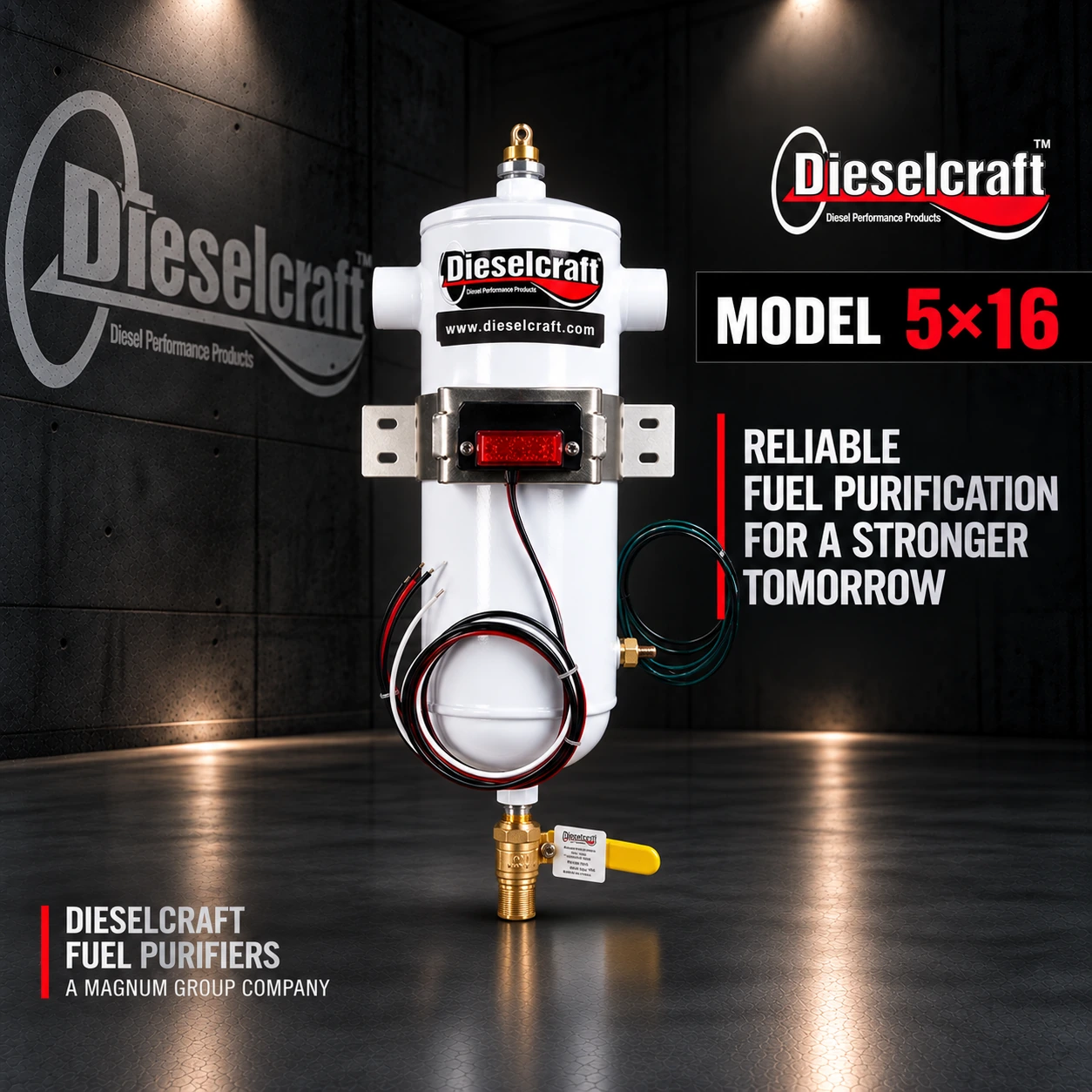
Dieselcraft 5×16

5×16

Need a compact installation?

Start by comparing the 5×16 with your available space, line connections and actual pump flow. Confirm its suitability against the current model data sheet.
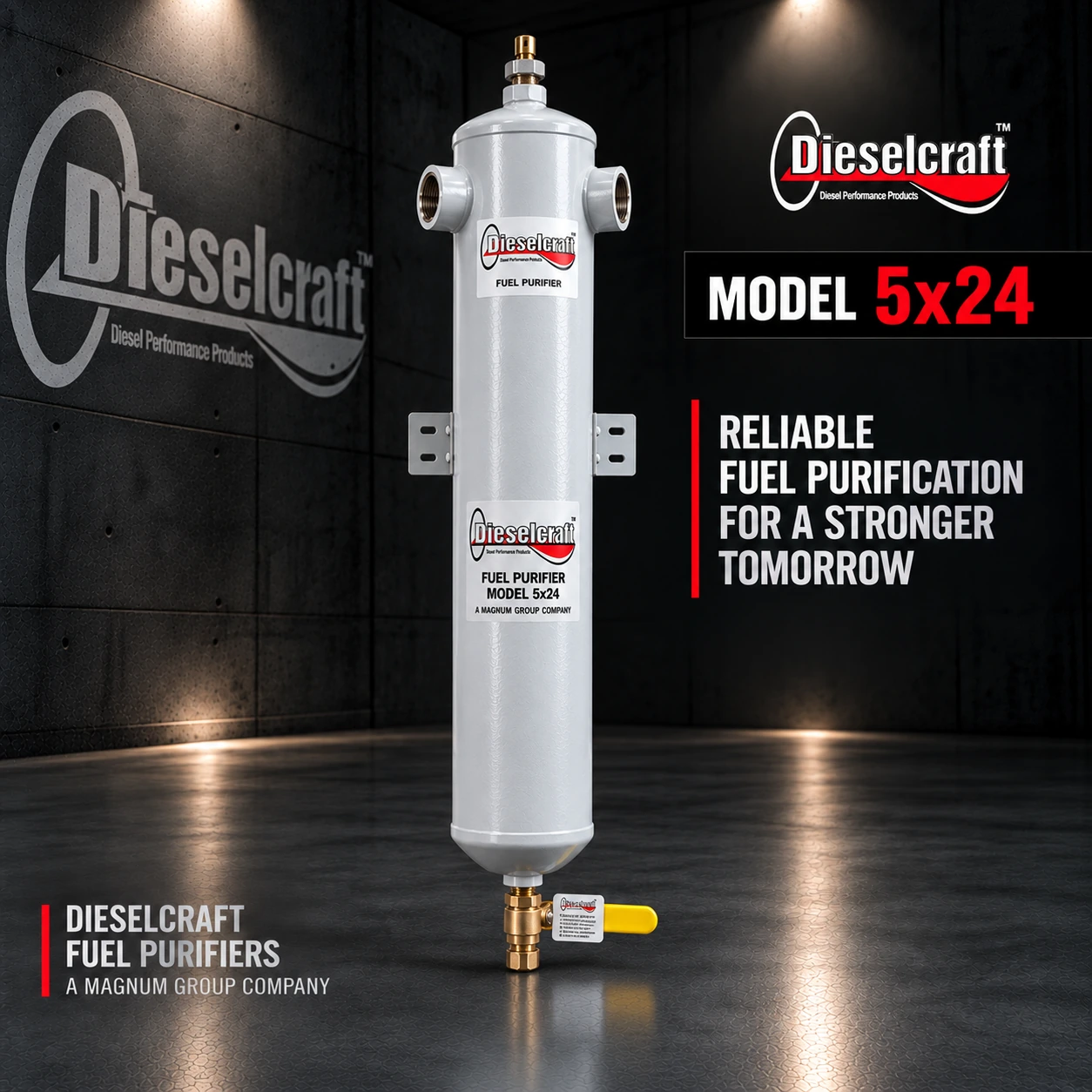
Dieselcraft 5×24

5×24

Comparing a mid-length chamber?

Include the 5×24 when reviewing a stationary or circulation duty. Match the operating flow and installation dimensions together.
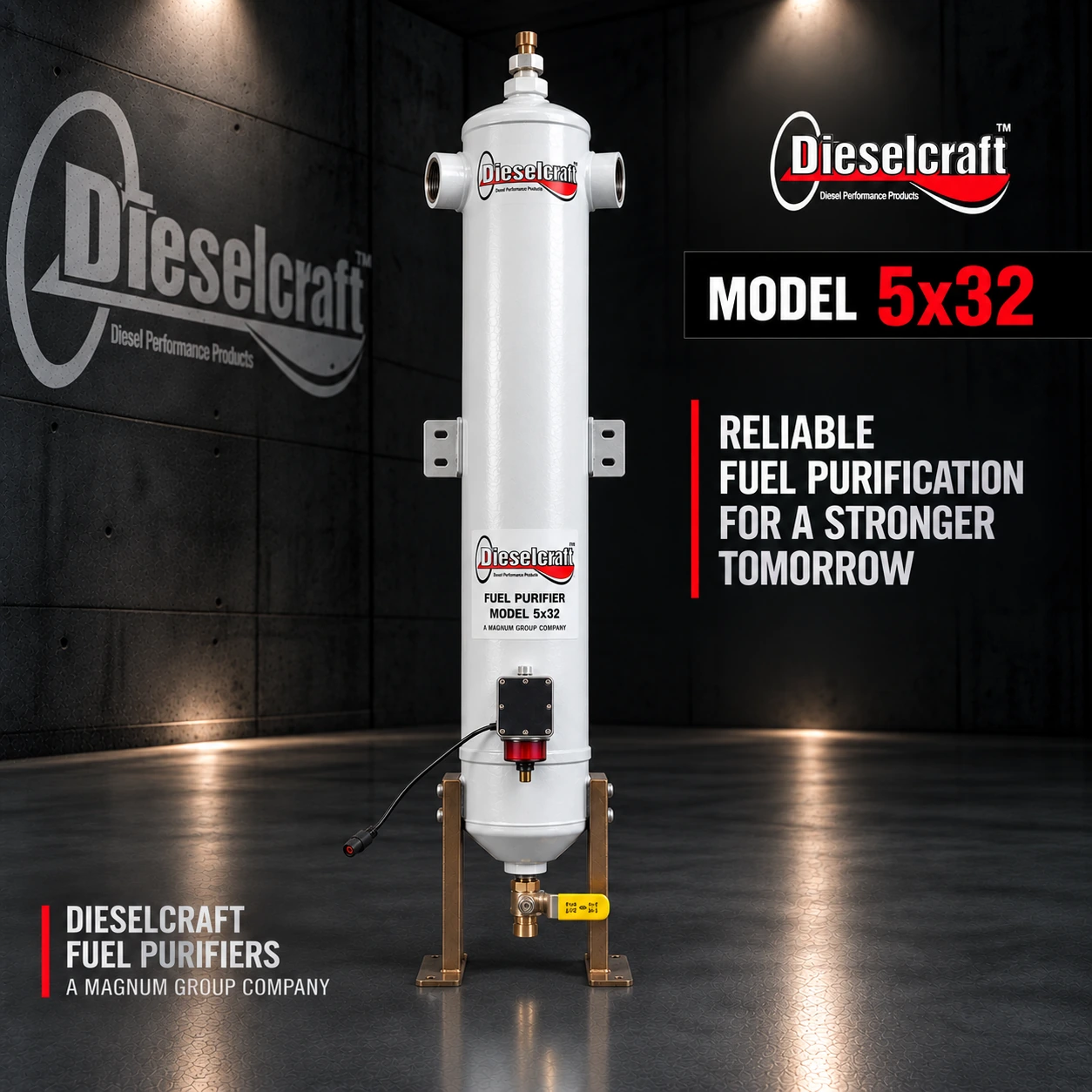
Dieselcraft 5×32

5×32

Considering a longer chamber?

Compare the 5×32 with the 5×24 using the confirmed flow and available height. Chamber length alone does not determine the correct model.
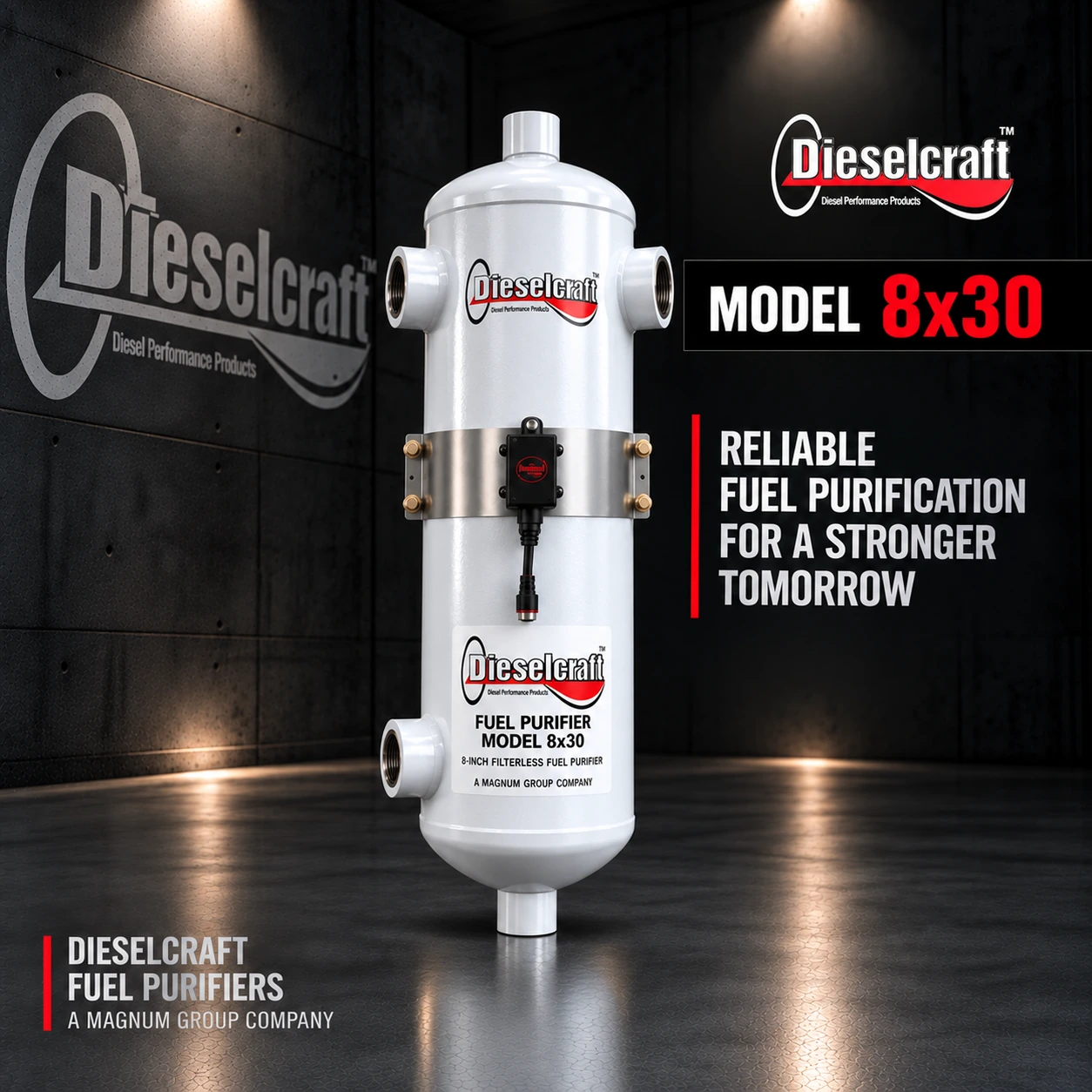
Dieselcraft 8×30

8×30

Planning a larger installation?

Include the 8×30 when assessing larger equipment, fuel transfer or fuel-dock duties. Check the flow, connection sizes and support requirements.
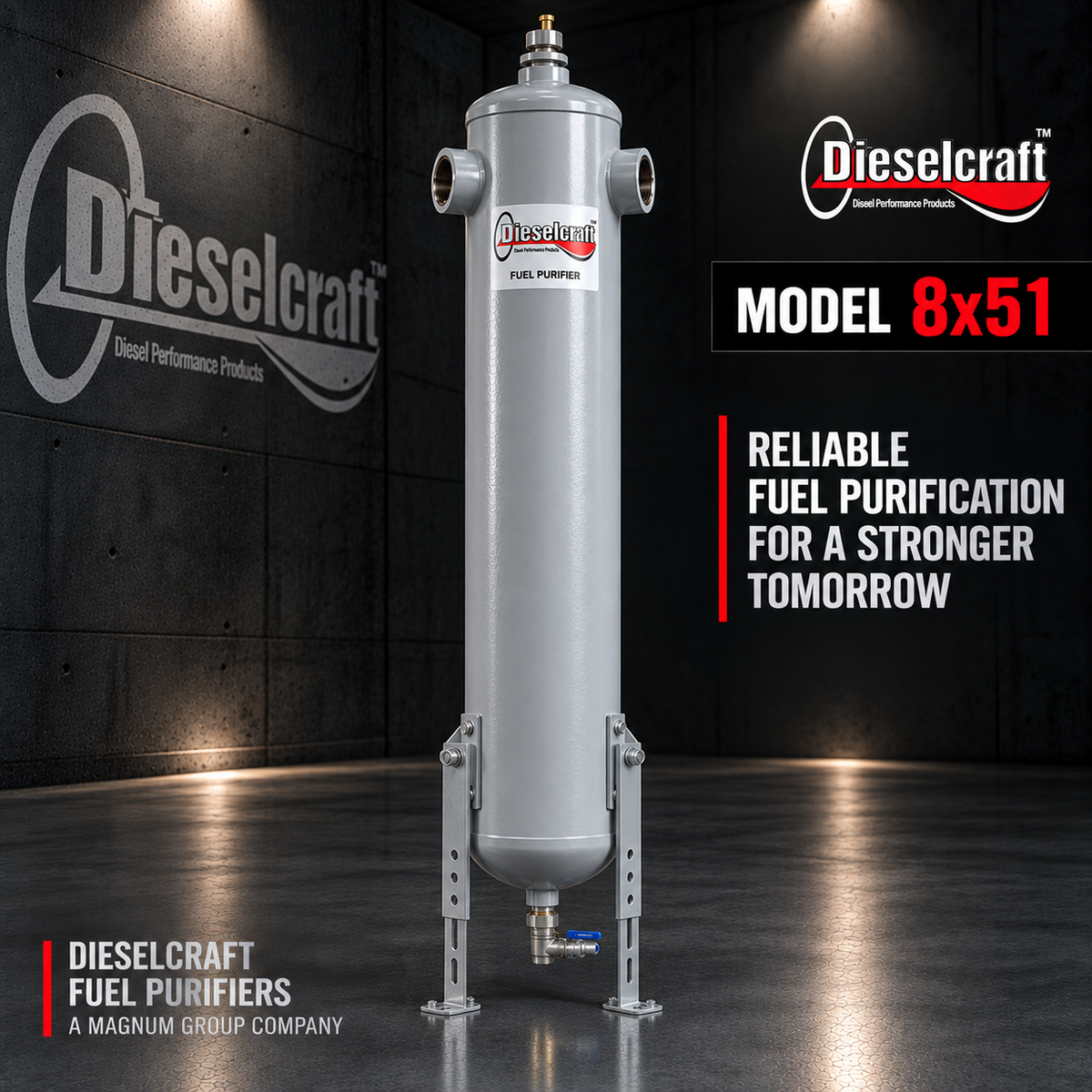
Dieselcraft 8×51

8×51

Evaluating a larger fuel-handling duty?

Compare the 8×51 with the 8×30 using normal and peak flow, mounting space and draining access. Obtain confirmation for your operating conditions.

When should you assess purification or polishing?

For free-water and heavy-contamination separation in a fuel line, assess the purifier at the proposed installation point. For cleanup of bulk stored fuel, assess a complete polishing loop including pumping, separation and appropriate filtration.

A clear selection workflow

  1. Define the application, fuel type and contamination condition.
  2. Record normal and peak flow through the purifier.
  3. Check pressure, connections, space and mounting.
  4. Compare current model data sheets with system requirements.
  5. Confirm suitability, draining and follow-up verification.

Do not size by engine horsepower or tank volume alone. Purification does not replace required fine filtration or address every aspect of fuel quality.

Need help choosing a model?

Prepare the equipment and pump models, flow, line pressure, connection sizes, available space and a system photo or sketch. For a tank-circulation duty, add the tank volume and cleanup objective.

Read the Complete Fuel Purifier Selection Guide

Learn how to assess flow, installation requirements and separation limits in the Technical Hub.

Frequently Asked Questions (FAQ)

Common questions about filterless fuel purification and Dieselcraft's technology

A Dieselcraft filterless fuel purifier separates free water and heavy contamination from diesel fuel using a long residence-time chamber and proprietary separation media — not a replaceable filter cartridge. Unlike a conventional spin-on fuel filter or coalescing water separator, there is no filter element to buy, stock, or change; contamination and water settle out and are removed through a bottom drain valve. This eliminates recurring filter-replacement cost and the risk of a clogged filter starving the engine of fuel. ANKORZ, as Dieselcraft’s Strategic Fuel Solutions Partner across Saudi Arabia, the UAE, Qatar, Oman, and Bahrain and the wider Middle East, supplies the full Dieselcraft filterless purifier range for stationary diesel systems.

Model selection is based on maximum flow rate (GPM) and the stated engine horsepower range: the 5×16 (15 GPM, 400–1,200 HP) suits compact stationary pumps and generators; the 5×24 (20 GPM, 600–1,500 HP) suits circulation pumps rated 4–7 GPM; the 5×32 (18 GPM, 600–1,500 HP) suits higher-flow pumps rated 8–18 GPM needing maximum residence time; the 8×30 (25 GPM / 1,500 GPH, 1,200–2,000 HP) suits stationary pumps, gen sets, locomotives and fuel docks; and the 8×51 (40 GPM / 2,400 GPH, 1,200–2,000 HP) is the highest-flow unit for high-volume fuel docks and continuous-duty stationary systems. ANKORZ can match flow rate and engine range to the correct model for a Gulf-region installation.

Maintenance is limited to periodically draining accumulated water and sediment from the bottom drain valve — there is no filter cartridge to replace, clean, or dispose of. All Dieselcraft purifiers in the range carry a five-year warranty and are rated to remove 99% of water and 95–98% of heavy particles from diesel fuel, so drain frequency depends on fuel quality and contamination load rather than a fixed filter-change interval.

No. Dieselcraft purifiers are designed and rated for diesel fuel; the 8×30 and 8×51 models are explicitly stated as not for use with gasoline, and the same diesel-only design applies across the 5-inch series (5×16, 5×24, 5×32).

All models install vertically with a bottom drain valve, using forged-steel NPT inlet/outlet connections (1/2 in. on the 5×16, 1 in. on the 5×24 and 5×32, 2 in. on the 8×30 and 8×51). Overall height ranges from about 17.8 in. (5×16) to 35.86 in. (5×32) in the 5-inch series, and about 31.93 in. for the 8×30 tank; the 8×51 adds adjustable legs bringing port height to 42.6–46.6 in. Sufficient vertical clearance and access to the bottom drain valve should be planned for at installation.

Fuel purification (this product line) is inline, continuous, filterless separation of free water and heavy contamination from fuel as it flows toward the engine, with no moving parts beyond the drain valve. Fuel polishing is a separate, typically portable or skid-mounted process that circulates fuel out of a storage tank, through filtration and/or water removal, and back into the tank to clean up bulk stored fuel — see ANKORZ’s Fuel Polishing Solutions for tank-cleaning systems.

Standby generators, belly tanks, and bulk diesel storage across Saudi Arabia, the UAE, Qatar, Oman, and Bahrain often sit idle between uses while ambient temperatures swing significantly day to night, causing condensation inside the tank. This water ingress promotes microbial growth and sediment buildup over time even when fuel was clean at delivery. A Dieselcraft purifier installed ahead of engine filtration continuously removes this water and heavy contamination before it can damage injectors, fuel pumps, or filters.

Every model in the Dieselcraft filterless purifier range — 5×16, 5×24, 5×32, 8×30, and 8×51 — is rated to remove 99% of free water and 95–98% of heavy particles from diesel fuel before it reaches the engine’s own filtration system.

No. Separation relies on gravity and residence time as fuel flows through the chamber — there are no moving parts, filter media, or electrical components in the purifier itself. Water and sediment collect at the bottom and are removed through the manual drain valve.

Fuel care works best as a sequence

Purification protects fuel on its way to your equipment. Pair it with a test to prove the result, and with polishing for fuel that is already stored.

Step 1 · Test

Know what you are treating

Water, particles or microbial growth? A quick field test tells you what the fuel needs before you choose equipment.

Explore Fuel Testing
Step 2 · Purify

Protect fuel at the point of use

Filterless purifiers separate free water and heavy contamination on the way to generators, pumps and equipment.

You are here
Step 3 · Polish

Clean the fuel already in your tanks

Portable and stationary polishing systems recirculate stored diesel until it tests clean.

Explore Fuel Polishing

Not sure where to start? Share your tank size, fuel type and site power, and our technical team will recommend the next step. Talk to the technical team

Ready to Protect Your Fuel System?

Contact our team for fuel purification solutions tailored to your operational needs.

Request Fuel Equipment or Parts

Tell us which fuel product or replacement part you need. Share specifications or a photo, and our team will review availability and contact you.


Request a Quote

Fill out the form below and we will get back to you with a quotation as soon as possible.