Fuel Testing Solution

Fuel Testing Solution

Rapid, Field-Proven Diesel Fuel Diagnostics for Reliable Operations 

Designed For Technical Professionals

Our fuel testing solutions serve engineers and operators across industries


Marine operators & ship owners

Power plants & generator operators

Industrial facilities

Fleet & fuel storage operators

Maintenance and reliability engineers

Why Fuel Testing Matters

Unverified diesel fuel can cause serious operational issues and costly downtime.
Injector and fuel pump damage
Microbial contamination (diesel bug)
Water ingress and corrosion
Engine downtime and unexpected failures
Non-compliance with operational standards

ANKORZ Solution Overview

ANKORZ helps you select Dieselcraft field test kits for water, clarity or microbial growth and plan sample quantities. These checks support investigation and maintenance decisions; use appropriate laboratory analysis when precise measurements or formal fuel acceptance are needed.
Detect microbial contamination
Check for detectable free and suspended water
Verify fuel clarity and condition
Make informed maintenance decisions

Diagnostic Workflow

From problem identification to confident operation – a systematic approach

Suspected fuel issue

Identify potential fuel quality concerns

1

On-site fuel sampling

Collect fuel samples for testing

2

Rapid diagnostic testing

Perform on-site analysis

3

Result interpretation

Understand test outcomes

4

Maintenance decision

Plan treatment or action

5

Continued operation

Resume with confidence

6

Diagnostic Tools

Professional-grade fuel testing equipment for reliable on-site diagnostics
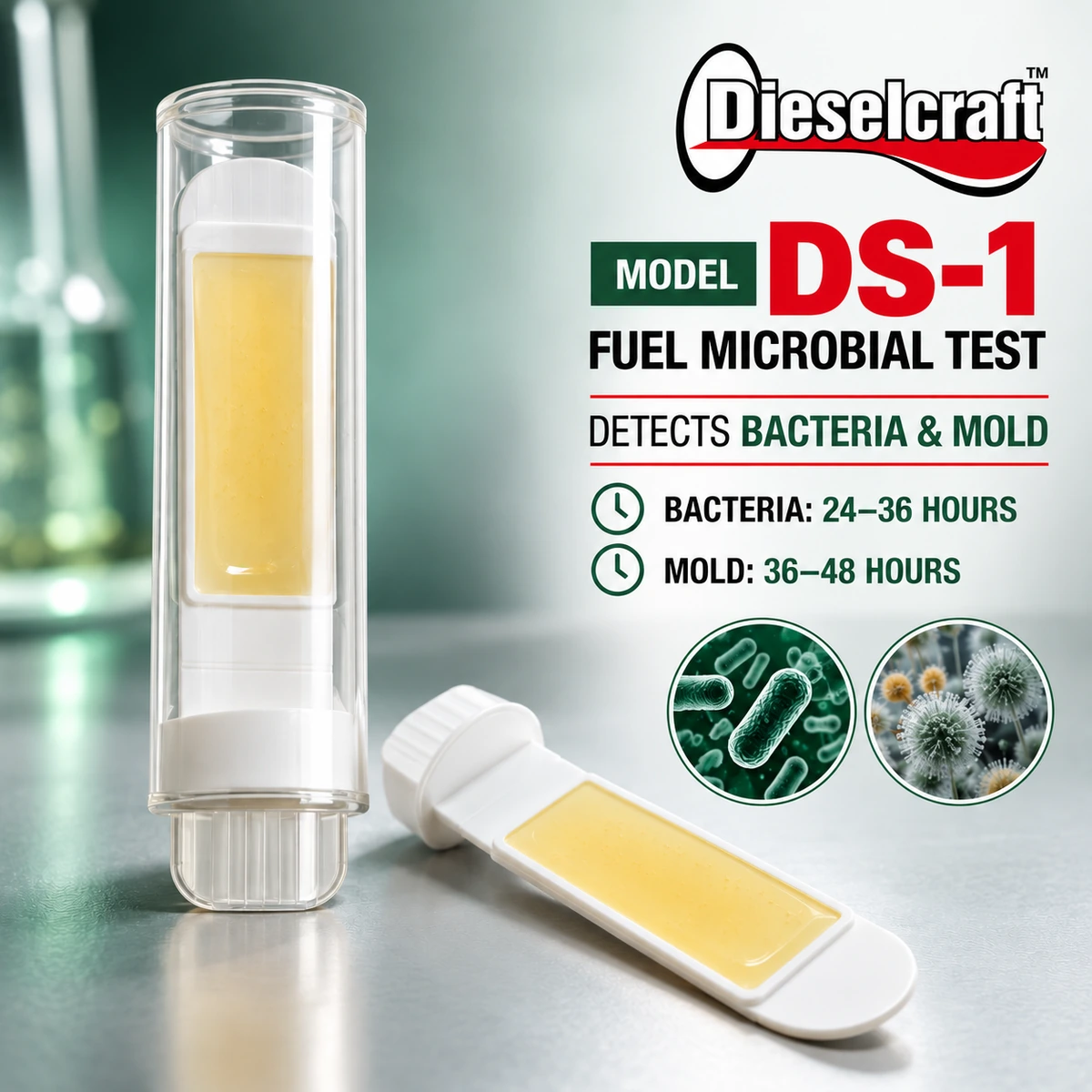
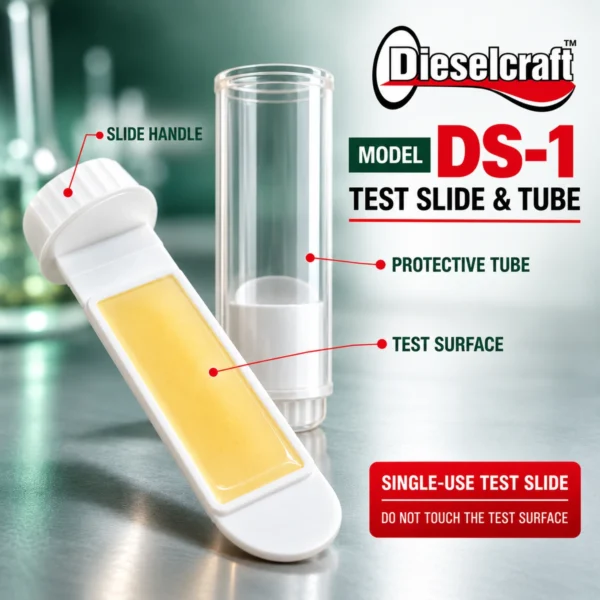
Dieselcraft DS-1 microbial test slide and protective tube for diesel fuel.

DS-1 – Fuel Microbial Contamination Test Kit

Purpose:
Screens a diesel sample for bacterial and mold growth using a single-use test slide.
When to Use:

1 test per kit — one single-use slide for one diesel sample.
Result: bacteria 24–36 hours; mold 36–48 hours.
Compatible fuel: diesel only.

A positive result calls for investigation of water and corrective maintenance. A negative result does not certify overall fuel quality.

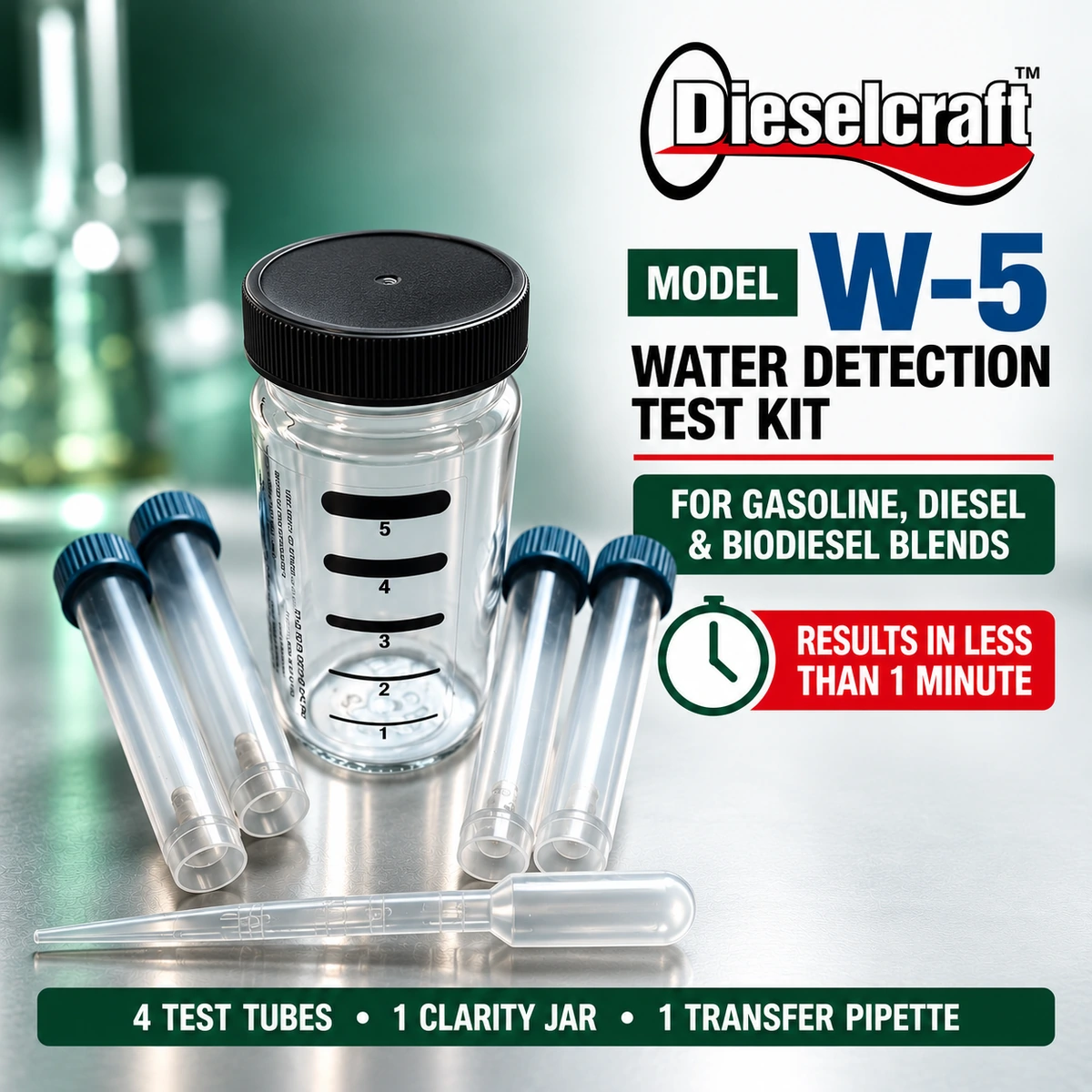
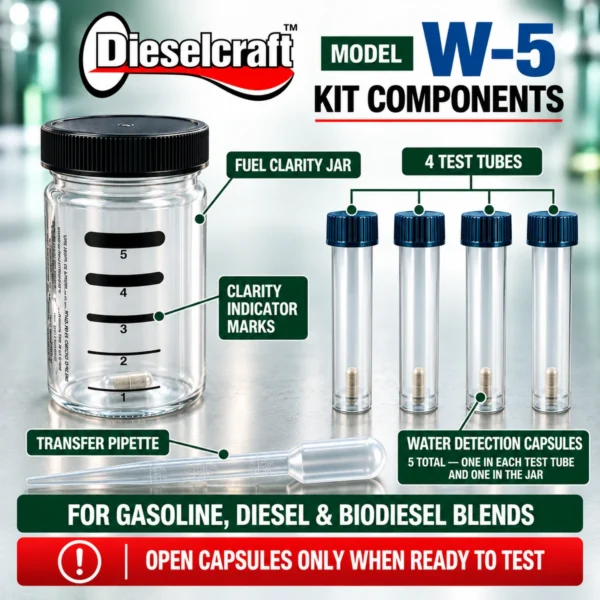
Dieselcraft W-5 kit with four test tubes, a clarity jar and a transfer pipette.

W-5 – Water Detection Test Kit

Purpose:
Detects free and suspended water in compatible fuels through a qualitative colour reaction.
When to Use:

Up to 5 water checks per kit — one capsule per check.
Result: less than 1 minute.
Compatible fuels: gasoline, diesel and biodiesel blends.

A qualitative field check that supports investigation and maintenance decisions.

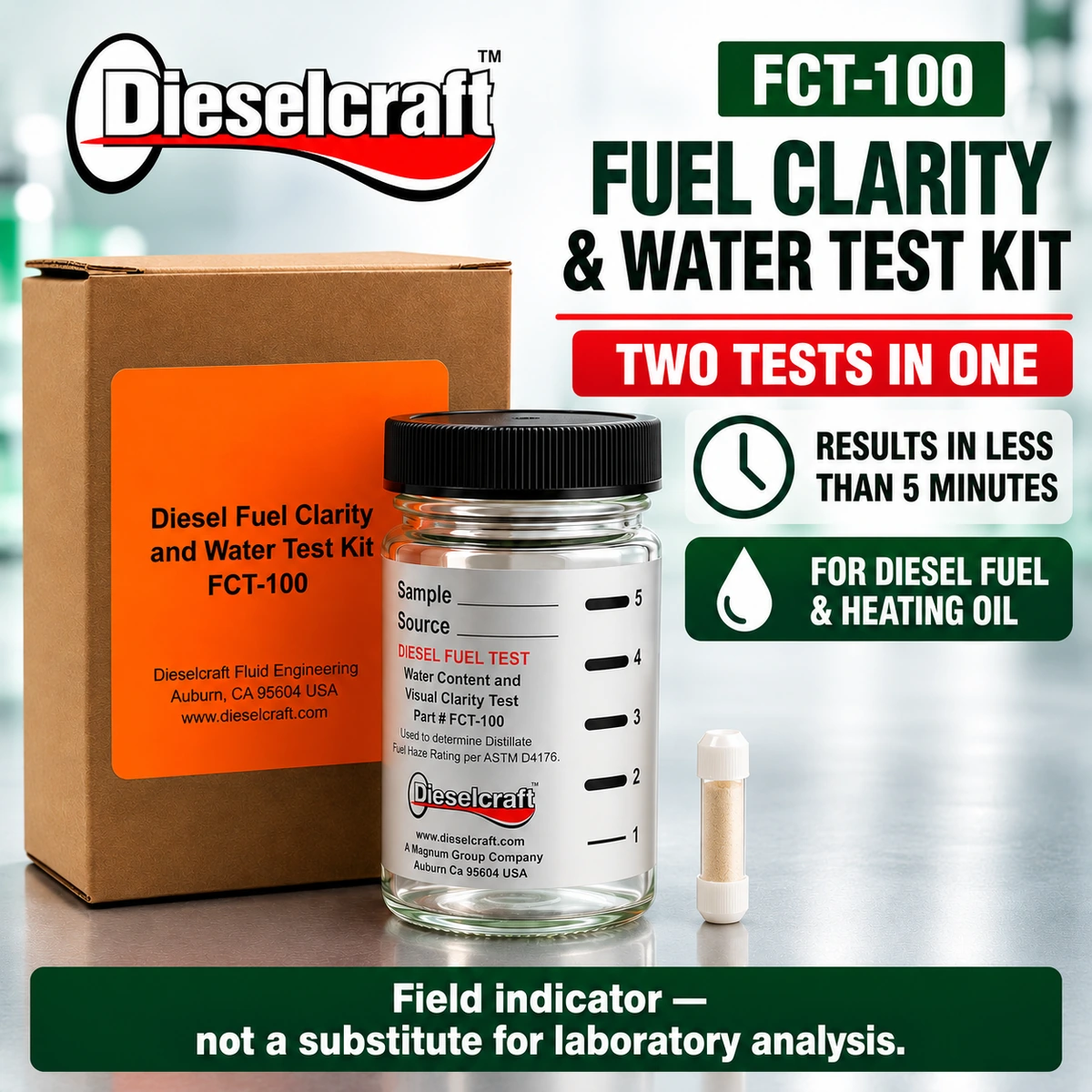
Dieselcraft FCT-100 fuel clarity and water test jar with reagent capsule.

FCT-100 – Fuel Clarity & Water Test Kit

Purpose:
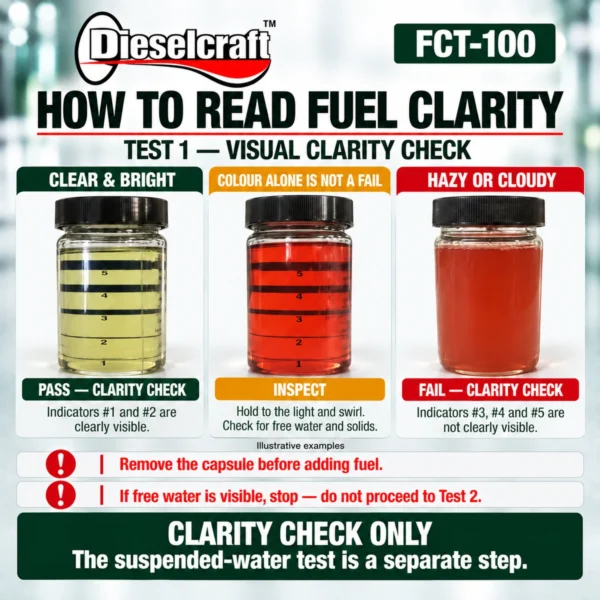
Checks diesel or heating-oil clarity, visible free water and solids, followed by a suspended-water check when appropriate.
When to Use:

One sample, two stages: clarity + water using the supplied capsule.
Result: less than 5 minutes.
Compatible fuels: diesel and heating oil.

If visible free water is found in Test 1, stop and skip Test 2. A general field indicator; further analysis may be needed.

How to choose the right fuel test
W-5 test kit

Need a fast water check?

Choose W-5 when the main question is detectable free or suspended water. Check fuel compatibility and allow one capsule for each water check.
FCT-100 test kit

Need clarity and water on the same sample?

Choose FCT-100 for diesel or heating oil to examine clarity, visible water and solids before the reagent-based water stage.
DS-1 test kit

Suspect bacteria or mold?

Choose DS-1 for a diesel microbial-growth check. Allow up to 48 hours and use a new slide for every sample. Pair it with a water/clarity check when investigating the source.

When should you test?

Plan checks around storage conditions, operating needs and your maintenance programme: a new delivery, fuel returning to service after storage, suspected contamination, and verification after corrective maintenance. These are planning examples, not a universal interval. Follow applicable equipment requirements and site procedures.

A clear field-testing workflow

  1. Define the question.
  2. Plan and label samples.
  3. Select a compatible kit and follow its instructions.
  4. Record and interpret results.
  5. Investigate or maintain as needed.
  6. Verify with an appropriate follow-up check.

Field checks address specific contaminants. A clear sample or negative microbial slide does not establish every aspect of fuel quality. FCT-100 is a general field indicator and does not replace laboratory analysis.

Need help choosing a kit or planning quantities?

Tell us the fuel type, what you want to check, the number of sample locations and whether you need repeat or post-maintenance tests. Count sample locations and retests separately.

Read the Complete Fuel Test Selection Guide

Learn how to plan samples, choose checks and interpret results in the Technical Hub.

Frequently Asked Questions (FAQ)

Common questions about fuel testing and our diagnostic solutions

Set the testing schedule from the generator manufacturer requirements, fuel storage conditions, operating needs and site maintenance plan. The supplied kit documents do not establish a universal annual interval or mandatory test panel for every Gulf installation.

Use W-5 for a compatible-fuel water check, FCT-100 for diesel/heating-oil clarity and water, and DS-1 for diesel bacteria and mold. Use appropriate laboratory analysis when precise measurements or formal fuel acceptance are required.

Water in stored diesel is an important part of a contamination investigation. A water or clarity check helps identify what needs attention, while DS-1 checks for bacterial and mold growth. Investigate the source of water and the storage conditions rather than assuming every Gulf tank has the same contamination rate.

A positive DS-1 result is a reason to investigate water first. Dieselcraft advises finding and removing water, then assessing fuel polishing before deciding on treatment. Do not treat a positive slide as an automatic instruction to add biocide; follow the product instructions and the applicable site procedures.

DS-1 uses a two-sided slide to screen a diesel sample for bacterial and mold growth. Read bacterial growth at 24–36 hours and mold at 36–48 hours using the supplied instructions. Each kit supplies one single-use slide for one sample; do not reuse it. A negative reading means no growth was detected under the test conditions, not complete fuel certification.

Start with the visual clarity stage. If visible free water is present, the sample has failed: stop and skip Test 2. Otherwise follow the manufacturer clarity instructions: a clear view of marks #1 and #2 indicates PASS; haze obscuring #3, #4 or #5 indicates FAIL.

For the water stage, use the supplied capsule and the FCT-100 instructions. Let the powder settle before interpreting its colour. This is a general field indicator, not a precise laboratory water measurement or a universal fuel-acceptance limit.

W-5 checks for detectable free and suspended water in compatible fuels through a qualitative colour reaction. Follow the W-5 instructions for the selected container and fuel type; pink indicates a water-related failure under the test conditions. Do not interpret it as an exact ppm reading, dissolved-water measurement, or proof of zero water when white. Fuel-blend sensitivity varies. The kit supplies five capsules for up to five single-use water checks.

Choose W-5 for a rapid water check in gasoline, diesel or biodiesel blends; FCT-100 for clarity and water on a diesel or heating-oil sample; and DS-1 for bacteria and mold in diesel. Count sample locations and retests separately. See the selection section above and the Technical Hub guide for sampling and result interpretation.

The supplied FCT-100 instructions specify diesel fuel and heating oil. W-5 includes gasoline, diesel and biodiesel blends; DS-1 is for diesel only. Do not transfer fuel compatibility from one model to another.

Follow the sampling instructions for the selected kit. DS-1 and FCT-100 recommend bottom-of-tank sampling when possible; W-5 allows checks at multiple locations. Label each sample with its source, date and purpose. A result represents the sample tested, so separate locations and later retests need their own sampling and reagent allocation.

No. The supplied test-kit documents do not establish a universal acceptance limit for every engine or installation. Use the applicable equipment requirements and an appropriate analytical method for precise water concentration, particle size or formal fuel acceptance. A field PASS answers the selected check, not every aspect of fuel quality.

Do not reuse a DS-1 slide. Follow the disposal guidance in the official DS-1 PDF and the applicable site waste-handling procedures. Do not use a generic household disposal method in place of those instructions.

Fuel care works best as a sequence

Found water, sediment or microbial growth? The test is step one. Here is where it leads.

Step 1 · Test

Know what you are treating

Water, particles or microbial growth? A quick field test tells you what the fuel needs before you choose equipment.

You are here
Step 2 · Purify

Protect fuel at the point of use

Filterless purifiers separate free water and heavy contamination on the way to generators, pumps and equipment.

Explore Fuel Purification
Step 3 · Polish

Clean the fuel already in your tanks

Portable and stationary polishing systems recirculate stored diesel until it tests clean.

Explore Fuel Polishing

Not sure where to start? Share your tank size, fuel type and site power, and our technical team will recommend the next step. Talk to the technical team

Ready to Ensure Your Fuel Quality?

Contact our team for professional fuel testing solutions tailored to your operational needs.

Request Fuel Equipment or Parts

Tell us which fuel product or replacement part you need. Share specifications or a photo, and our team will review availability and contact you.

Can’t find the product you’re looking for? Upload a photo and we will find it for you.


Request a Quote

Fill out the form below and we will get back to you with a quotation as soon as possible.