Summary
Diesel fuel stored for months in standby generators, marine vessels, or industrial tanks across Saudi Arabia, the UAE, Kuwait, Qatar, Oman, and Bahrain degrades in three predictable, interlinked ways — and testing at the right interval catches the problem before it reaches the engine.
Why Does Stored Diesel Fuel Degrade in the GCC?
Quick Answer: Untreated diesel fuel typically starts degrading within 6–12 months due to three linked factors — oxidation, water accumulation, and microbial growth — which compound each other faster in tanks exposed to the region's sharp day-to-night and seasonal temperature swings.
Standby generators, marine vessels, and industrial fuel storage across the GCC and the wider Middle East share a common vulnerability: diesel fuel that sits unused for months at a time, in tanks exposed to sharp temperature swings between day and night and across seasons. Properly stabilized fuel can sometimes last 18–24 months, but any fuel older than two years should be tested before it's relied upon — particularly for standby generators that may not run for months between activations.
The degradation process is driven by three linked factors:
- Oxidation — fuel reacts with oxygen over time, forming sludge and gum deposits.
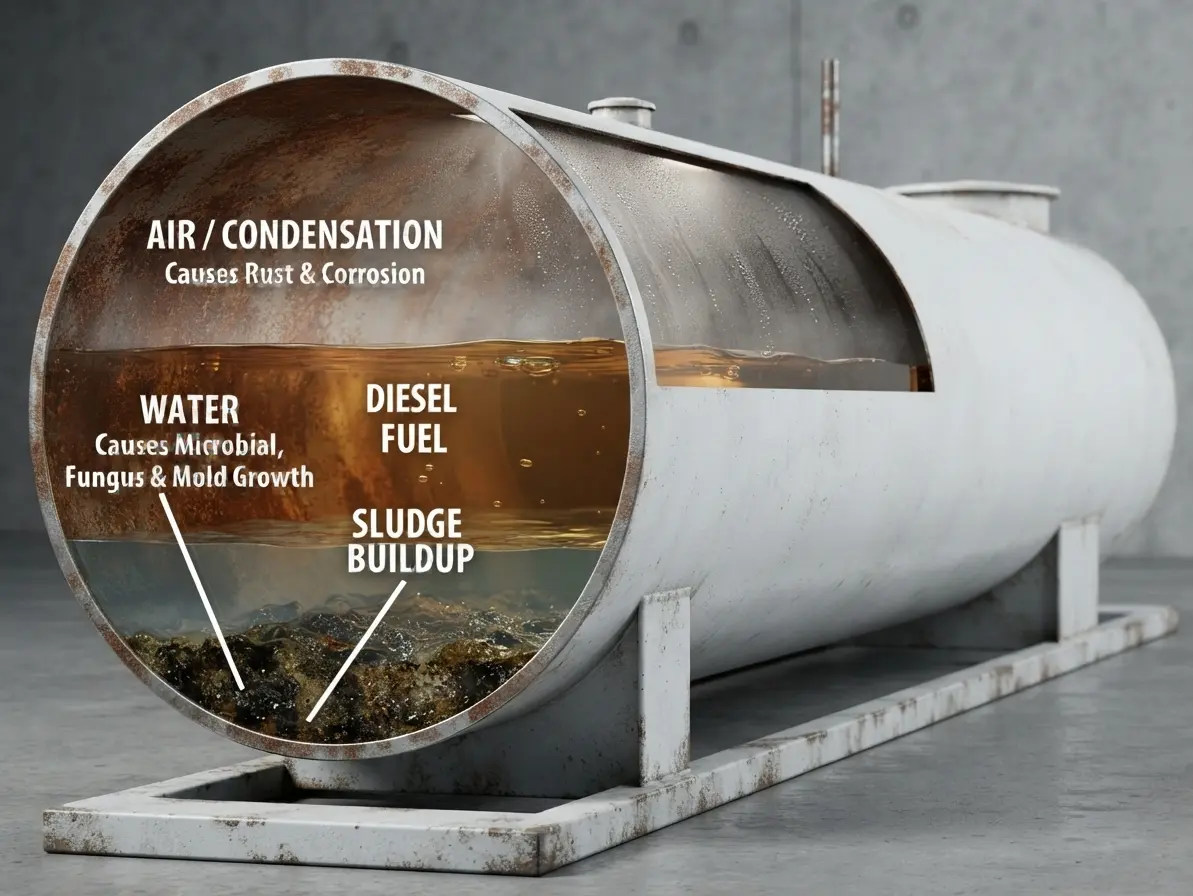
- Water accumulation — condensation collects inside tanks due to temperature swings, especially in "belly tanks" and low-turnover storage common across the region's day-to-night and seasonal temperature range.
- Microbial growth — bacteria and fungi ("diesel bug") establish at the fuel-water interface once water is present, feeding on hydrocarbons and producing byproducts that clog filters and corrode tank surfaces.
These three factors compound each other: water enables microbial growth, microbial growth produces acidic byproducts that accelerate corrosion and further oxidation, and the resulting sludge concentrates at the tank bottom — which is exactly where sampling needs to happen, not the top or middle of the tank.
What Are the Warning Signs of Contaminated Diesel Fuel?
Quick Answer: The strongest single warning sign is fuel filter plugging combined with a high fuel temperature alarm — together they point strongly toward fuel contamination rather than a purely mechanical issue, and should trigger immediate testing.
Operators managing standby generators, marine fuel systems, or fleet storage in Saudi Arabia, the UAE, Kuwait, Qatar, Oman, and Bahrain should treat any combination of the following as a signal to test immediately, rather than waiting for the next scheduled check:
- High fuel temperature alarms
- Frequent fuel filter plugging
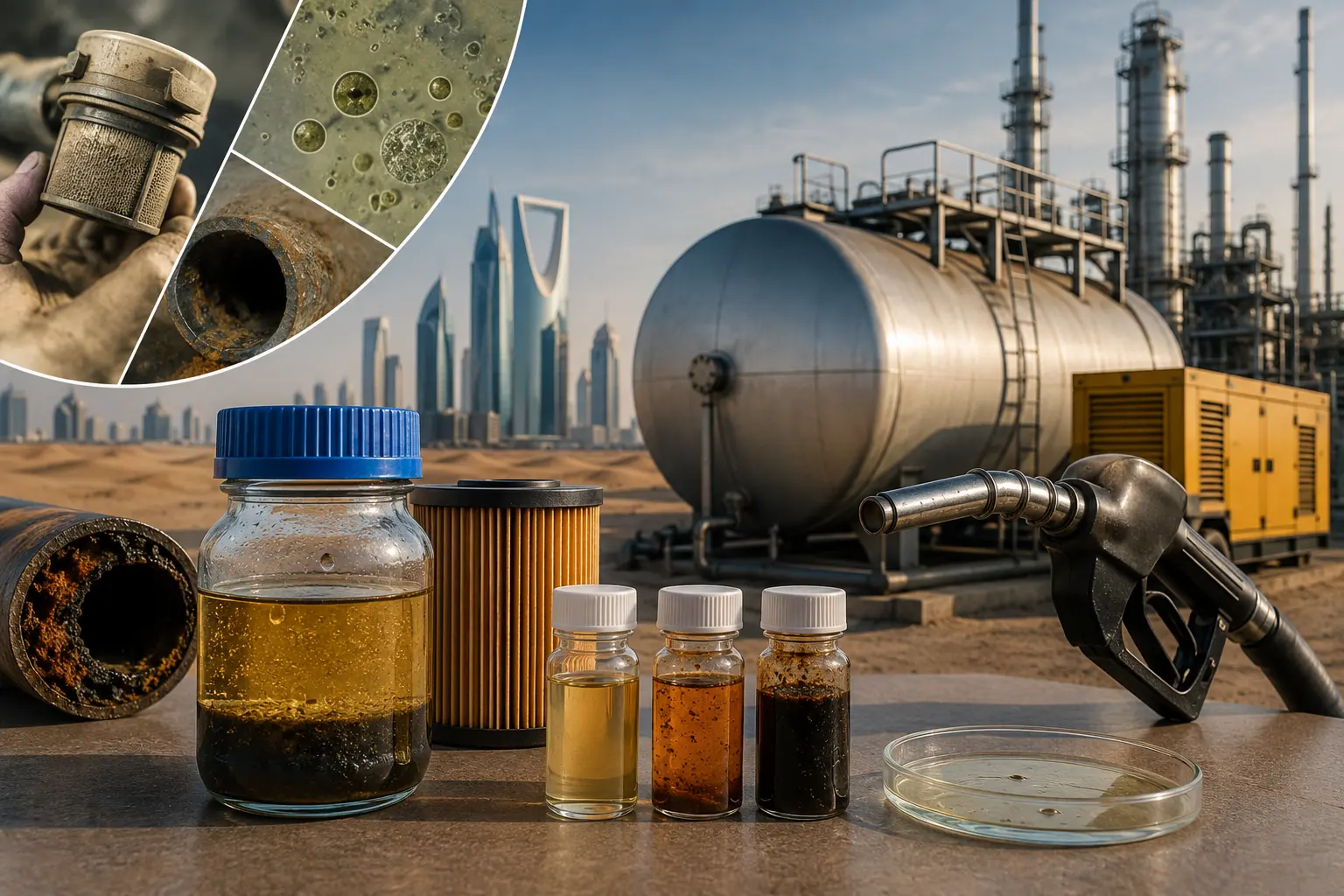
- Dark or cloudy diesel fuel
- Black slime inside tanks
- Hard starting on generators
- Injector noise
- Generator shutdown under load
- Water separator alarms
A single symptom can have several causes, but two or more occurring together points strongly toward fuel contamination rather than a purely mechanical issue.
Which Diesel Fuel Test Kit Should You Use?
Quick Answer: Use the W-5 kit for precise dissolved-water measurement, the FCT-100 for a fast visual clarity and sediment check, and the DS-1 when microbial growth ("diesel bug") is suspected — most operators in the region keep all three on hand for different situations.
Dieselcraft's field kits, available through ANKORZ, are designed for on-site diagnosis without laboratory delays:
| Kit | Detects | Result Time | Best Used |
|---|---|---|---|
| W-5 Water Detection Test Kit | Dissolved water (5–15 ppm range) | Same visit | After fuel delivery, or when condensation risk is high |
| FCT-100 Water and Sediment Test Kit | Fuel clarity, free water, sediment | Same visit | Routine checks, pre-startup inspection |
| DS-1 Fuel Microbial Contamination Test Kit | Bacteria/algae growth ("diesel bug") | 24–36 hours | When filter plugging or fouling is observed |
For fuel supporting regulated or critical facilities (hospitals, data centers, telecom), a fuller laboratory-standard panel may be warranted: water & sediment testing (ASTM D2709), oxidation stability testing (ASTM D2274), and particle count analysis (ISO 4406).
Recommended baseline schedule: test every 90 days and with every new fuel delivery. Standby generators specifically should be tested at minimum annually, with more frequent checks for tanks exposed to high humidity, temperature swings, or known water intrusion — conditions common across Saudi Arabia, the UAE, Kuwait, Qatar, Oman, and Bahrain.
What Should You Do After a Failed Fuel Test?
Quick Answer: Identify the specific problem first — water, sediment, microbial, or oxidation — then choose fuel polishing for moderate contamination, partial or full fuel replacement when oxidation is advanced, or tank maintenance to address the underlying water and sludge source.
A "pass" result means no visible contamination was found — a point-in-time result, not a permanent guarantee, especially for fuel that will continue sitting in storage. A "fail" result means contamination is present and treatment is needed before continued reliance on that fuel.
The correct sequence after a fail result is: test first to identify the specific problem, then choose the appropriate response:
- Fuel polishing — circulates stored fuel through filtration to remove water, sediment, and microbial contamination without draining the tank; effective for moderate contamination.
- Partial or full fuel replacement — needed when oxidation has progressed too far for polishing to reverse chemically.
- Tank maintenance — addressing the sludge and water source directly, particularly for belly tanks and low-turnover storage.
Fuel polishing restores fuel condition; it does not reverse chemical oxidation that has already progressed significantly. This is why testing before treating matters — polishing as a default fix without knowing the actual problem can waste time and cost on fuel that needs replacement instead.
Why Does Regional Support From ANKORZ and Dieselcraft Matter?
Quick Answer: ANKORZ, operated by Sea Sapphire Trading FZ-LLC, is Dieselcraft's Strategic Fuel Solutions Partner across the Middle East & GCC — giving operators in Saudi Arabia, the UAE, Kuwait, Qatar, Oman, and Bahrain direct access to genuine Dieselcraft equipment, full datasheets, and regional support instead of unverified third-party imports.
Dieselcraft Fluid Engineering, a division of Magnum Group, has worked in fuel and oil cleaning technology since 2002. ANKORZ, operated by Sea Sapphire Trading FZ-LLC, is Dieselcraft's verified partner and Strategic Fuel Solutions Partner across the Middle East & GCC, based in Saudi Arabia and the UAE with coverage extending across Kuwait, Qatar, Oman, Bahrain, and the wider Middle East.
This regional presence means operators get genuine Dieselcraft products with full datasheets, faster access than individual import from the US, and a single point of contact for both diagnostic tools (DS-1, W-5, FCT-100) and treatment technology (fuel polishing, bypass oil filtration, water separation) — rather than piecing together sourcing and technical guidance from separate, unverified suppliers. Explore the full range on the Fuel Testing & Treatment Solutions page.
Sources
- ANKORZ, "Fuel Testing & Treatment Solutions" — ankorz.com/fuel-testing-treatment-solutions
- ANKORZ, "Verified Partners" — ankorz.com/verified-partners
- ANKORZ product page — DS-1 Fuel Microbial Contamination Test Kit
- ANKORZ product page — W-5 Water Detection Test Kit
- ANKORZ product page — FCT-100 Water and Sediment Test Kit
- ANKORZ site footer (operating entity) — ankorz.com
- Internal cross-references (Q&A/FAQ Library): FAQ-001, FAQ-006, FAQ-008, FAQ-011, FAQ-012, FAQ-013, FAQ-015, FAQ-016, FAQ-017, FAQ-018, QA-007, QA-009