Summary
Chemical fuel additives do not remove water from diesel fuel — they either suspend it as microscopic droplets (emulsifiers) or separate it so it can be removed mechanically (demulsifiers). Understanding this difference matters for operators in Saudi Arabia, the UAE, Kuwait, Qatar, Oman, and Bahrain managing stored diesel fuel, since the wrong approach can let water keep circulating through the engine instead of actually leaving the fuel system.
What Do Emulsifiers Do to Water in Diesel Fuel?
Quick Answer: Emulsifiers break water into tiny droplets and keep them suspended throughout the fuel — the water doesn't leave the tank, it just becomes evenly distributed and less visible, which is only appropriate for very small amounts of water.
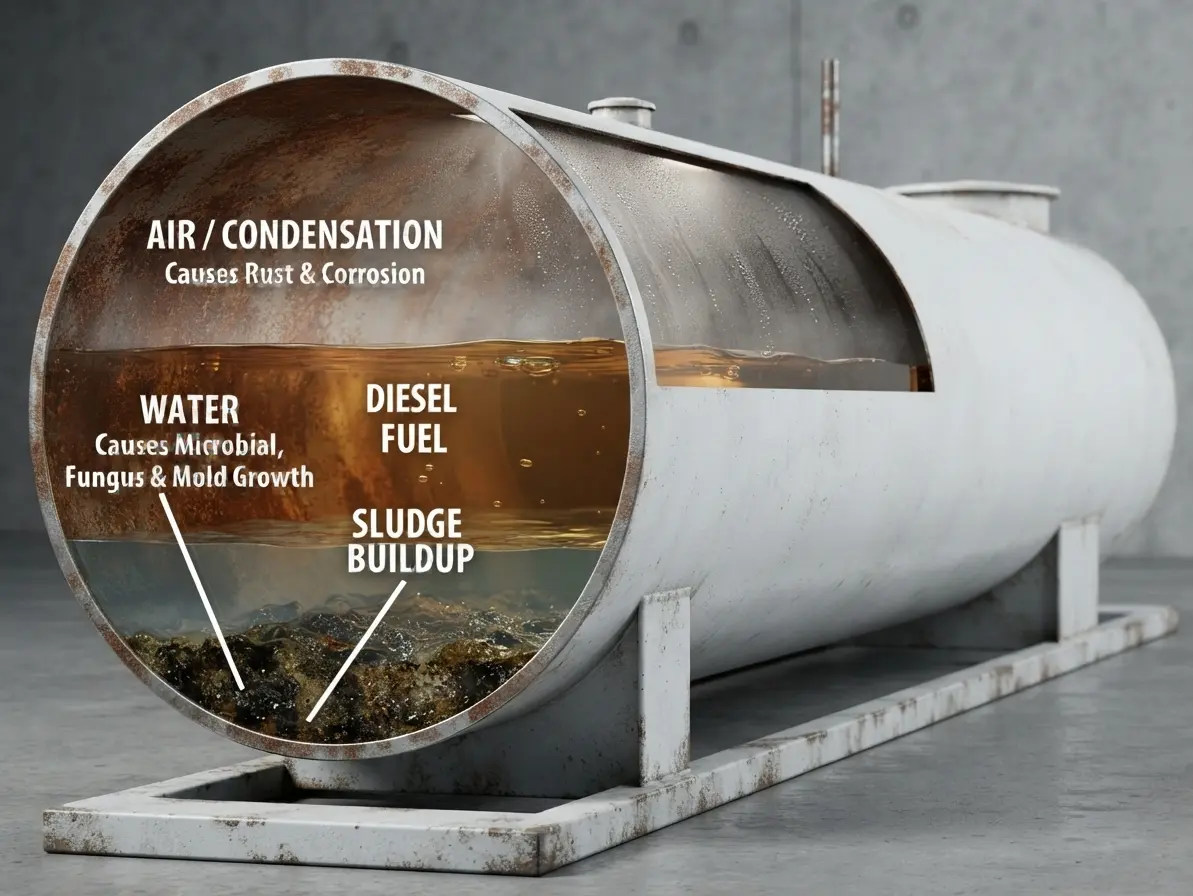
Emulsifying additives work by breaking water into microscopic droplets and keeping them dispersed throughout the fuel rather than allowing them to settle. This can make contamination less visually obvious, but it does not remove water from the system — the suspended droplets remain in the fuel and pass through with it, including into the engine and injectors. Emulsifiers are only suitable for handling very small, incidental amounts of water, not for fuel that has accumulated meaningful water content in storage.
What Do Demulsifiers Do to Water in Diesel Fuel?
Quick Answer: Demulsifiers do the opposite of emulsifiers — they cause suspended water droplets to combine into larger droplets that settle at the bottom of the tank, where they can be drained or removed with a water separator.
Demulsifying additives cause water droplets already present in the fuel to combine and coalesce into larger droplets. Because water is denser than diesel, these larger droplets settle to the bottom of the tank rather than staying dispersed. This settled water can then be removed through drains, water separators, or during a fuel polishing pass — it doesn't disappear on its own, but a demulsifier makes the mechanical removal step possible and effective. This is why demulsifiers are the preferred additive category for diesel storage tanks, rather than emulsifiers.
Emulsifiers vs. Demulsifiers: Which Should You Use?
Quick Answer: For diesel fuel storage, demulsifiers are the correct category — they separate water so it can actually leave the fuel system, while emulsifiers only keep it suspended and moving through with the fuel.
Emulsifiers
- Break water into tiny droplets.
- Keep water suspended in fuel.
- Suitable only for small amounts of water.
- Water passes through the engine.
Demulsifiers
- Cause water droplets to combine.
- Water settles at the bottom.
- Allows removal by drains or separators.
- Preferred for diesel storage tanks.
| Feature | Emulsifiers | Demulsifiers |
|---|---|---|
| Removes water | ❌ No | ❌ Not directly |
| Suspends water | ✔ Yes | ❌ No |
| Separates water | ❌ No | ✔ Yes |
| Suitable for storage tanks | ❌ No | ✔ Yes |
| Requires mechanical removal afterward | ❌ No (water stays suspended) | ✔ Yes |
Neither category removes water from a fuel system on its own. This is the central point operators need to understand: an additive alone is never the complete answer to water contamination — mechanical removal is always the step that actually eliminates water from the system.
What's the Best Practice for Removing Water From Stored Diesel Fuel?
Quick Answer: Combine a quality demulsifier with mechanical water removal — drain accumulated water regularly, use fuel-water separators, schedule fuel polishing when needed, and inspect storage tanks periodically.
For stored diesel fuel, the correct approach combines a demulsifier with mechanical water removal methods, rather than relying on chemical treatment alone. Before choosing a treatment approach, confirm water is actually present and estimate how much: the W-5 Water Detection Test Kit gives a same-visit reading of dissolved water content, which is covered in more detail in The Complete Guide to Diesel Fuel Contamination in the GCC.
Best Practice
For stored diesel fuel, combine a quality demulsifier with mechanical water removal methods.
- Drain accumulated water from tank bottoms regularly.
- Use fuel-water separators to continuously remove settled water.
- Schedule fuel polishing when water or sediment accumulation is confirmed.
- Inspect storage tanks periodically, particularly belly tanks and low-turnover storage where water tends to accumulate faster.
Remember: Fuel additives help manage water, but only mechanical removal actually eliminates it from the fuel system.
Why Does Regional Support From ANKORZ and Dieselcraft Matter?
Quick Answer: ANKORZ is Dieselcraft's Strategic Fuel Solutions Partner across the Middle East & GCC, giving operators in Saudi Arabia, the UAE, Kuwait, Qatar, Oman, and Bahrain access to both diagnostic testing (to confirm water is present) and treatment technology (fuel polishing, water separation) from a single regional source.
Diagnosing water contamination correctly, before choosing a treatment path, matters especially in the region's storage conditions — sharp day-to-night and seasonal temperature swings across Saudi Arabia, the UAE, Kuwait, Qatar, Oman, and Bahrain accelerate condensation inside tanks, particularly in belly tanks and low-turnover storage. ANKORZ, Dieselcraft's verified partner and Strategic Fuel Solutions Partner across the Middle East & GCC, provides both the diagnostic tools (DS-1, W-5, FCT-100) and the treatment technology (fuel polishing, water separation) operators need to move from "is there water in this fuel?" to "how do we actually get it out?" See the full range on the Fuel Testing & Treatment Solutions page.
Sources
- ANKORZ, "Fuel Testing & Treatment Solutions" — ankorz.com/fuel-testing-treatment-solutions
- ANKORZ, "Verified Partners" — ankorz.com/verified-partners
- ANKORZ product page — W-5 Water Detection Test Kit
- Related ANKORZ article — The Complete Guide to Diesel Fuel Contamination in the GCC (ART-001)
- Emulsifier/demulsifier mechanics: general fuel-treatment chemistry, consistent with industry-standard descriptions of water-in-fuel additive behavior.