Most standby generator fuel should be tested annually as a baseline, with critical emergency power systems — hospitals, data centers, telecom, and industrial sites — often requiring regular fuel polishing and contamination monitoring beyond the annual minimum. Recommended diagnostic tests for stored or older fuel include water & sediment testing (ASTM D2709), oxidation stability testing (ASTM D2274), microbial contamination testing, particle count analysis (ISO 4406), and cetane & lubricity testing. ANKORZ, as Dieselcraft’s Strategic Fuel Solutions Partner across the Gulf — Saudi Arabia, the UAE, Qatar, Oman, and Bahrain — and the wider Middle East, applies Dieselcraft’s field test kits (DS-1, W-5, FCT-100) for rapid on-site screening between formal annual tests, and can advise when a full laboratory-standard test panel is warranted.
Belly tanks and long-term fuel storage tanks often collect condensation due to temperature swings and low fuel turnover — exactly the conditions common across the Gulf, where standby generator fuel sits largely unused between activations while ambient temperatures swing significantly between day and night, and seasonally. Water accumulation from this condensation promotes oxidation and microbial growth, leading to sludge buildup at the bottom of the tank over time. This is a mechanical/climate cause, not a fuel-additive problem — additives may improve lubricity and anti-gel performance, but they do not remove sludge, water, oxidation byproducts, or microbial contamination already present. ANKORZ, as Dieselcraft’s Strategic Fuel Solutions Partner across Saudi Arabia, the UAE, Qatar, Oman, and Bahrain, and the wider Middle East, recommends bottom tank sampling specifically for belly tanks and low-turnover storage, since contamination concentrates at the lowest point.
No. Dieselcraft’s own DS-1 documentation is explicit: “Adding a biocide is NOT the next step.” When bacteria or mold react on the DS-1 slide, they typically form a biofilm — commonly called algae by operators — that physically protects the bacteria from biocides, making biocide treatment ineffective on its own. The root cause is water in the tank: bacteria and mold cannot establish without it. The correct first step is removing all water from the fuel tank before considering any biocide treatment. ANKORZ, as Dieselcraft’s Strategic Fuel Solutions Partner across Saudi Arabia, the UAE, Qatar, Oman, and Bahrain, and the wider Middle East, can advise on the correct sequence — water removal via fuel polishing or tank maintenance first, re-testing, and only then evaluating whether further biocide treatment is warranted.
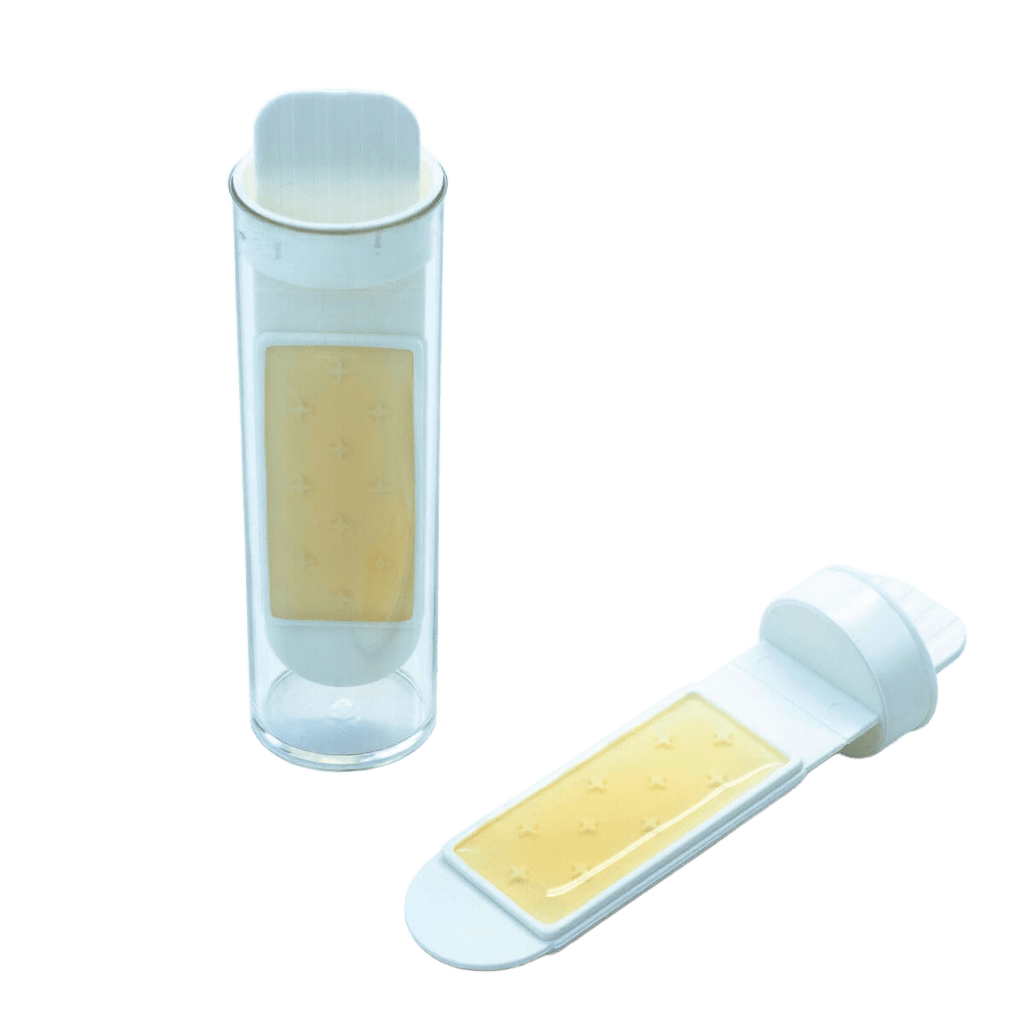
The DS-1 slide has two distinct testing sides, each calibrated to a different organism and timeline. The “white” side detects bacteria and typically shows a reaction between 24 and 36 hours after fuel exposure. The “off-white” side detects mold and requires 36 to 48 hours to develop a visible reaction. This is why Dieselcraft frames DS-1 as delivering a result “in less than 48 hours” — the full picture is only complete once both windows have passed. Procedurally: the slide is dipped in a fuel sample for 30 seconds, excess fuel removed, then stored in a dark location and inspected at 24, 36, and 48 hours. ANKORZ, as Dieselcraft’s Strategic Fuel Solutions Partner across Saudi Arabia, the UAE, Qatar, Oman, and Bahrain, and the wider Middle East, supplies the DS-1 kit regionally for operators confirming biological contamination on standby generator or marine fuel systems.
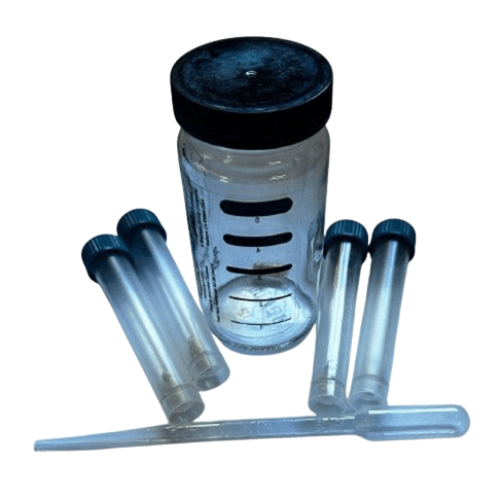
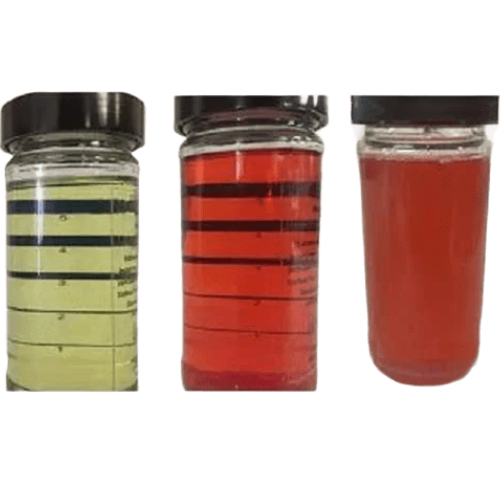
The FCT-100 is a two-part field test based on ASTM D4176, with results in under 5 minutes. Test One (Fuel Clarity): sample fuel from the bottom of the tank, fill the test jar past indicator rectangle #5, and check for haze. PASS means rectangles #1 and #2 remain clearly visible; FAIL means rectangles #3, #4, and #5 are not clearly visible, indicating solid contaminants or suspended water. Critically: if free water is visibly present, stop the test entirely — no need for Test Two. Test Two (Suspended Water), run only if Test One passes: 10 to 49 ppm water shows as pink spots, while more than 50 ppm turns the powder fully hot pink (FAIL). ANKORZ, as Dieselcraft’s Strategic Fuel Solutions Partner across Saudi Arabia, the UAE, Qatar, Oman, and Bahrain, and the wider Middle East, supplies FCT-100 kits regionally and can advise on fuel polishing or maintenance when a FAIL result is confirmed.
The W-5 is a rapid detection test for free and suspended water in gasoline, diesel fuel, and biodiesel blends, delivering a result in under one minute. A reaction powder is mixed with a fuel sample: pink spots signal water at a low, detectable level (ppm range); the powder turning fully “hot pink” signals a higher concentration and is a clear FAIL requiring corrective action — typically water removal via fuel polishing or tank maintenance. For red-dyed diesel, Dieselcraft’s documented method is to draw off the fuel to the last half-inch and examine the reaction against a white paper towel. ANKORZ, as Dieselcraft’s Strategic Fuel Solutions Partner across Saudi Arabia, the UAE, Qatar, Oman, and Bahrain, and the wider Middle East, supplies the W-5 kit regionally as the fastest first-response tool when water contamination is suspected.
Note for internal review: Dieselcraft’s own reference materials are not fully consistent on the exact ppm threshold for a full “hot pink” fail — confirm the precise number directly with Dieselcraft before quoting it in a technical proposal or compliance document.
Each kit tests for a different type of contamination, and they are complementary rather than redundant. DS-1 detects biological contamination — bacteria and mold growth (“diesel bug”) — with results developing over 24 to 48 hours. FCT-100 is a two-part physical/visual test based on ASTM D4176 (fuel clarity and suspended water), with results in under 5 minutes. W-5 is a fast, focused water detection test covering gasoline, diesel, and biodiesel blends, with results in under one minute. ANKORZ, as Dieselcraft’s Strategic Fuel Solutions Partner across Saudi Arabia, the UAE, Qatar, Oman, and Bahrain, and the wider Middle East, supplies all three kits regionally: for a complete fuel-quality picture, operators typically use W-5 or FCT-100 for immediate water/clarity screening, and DS-1 to confirm biological contamination when filter plugging or fuel darkening suggests it.
No — FCT-100 is documented specifically for diesel fuel and heating oil, with no mention of gasoline compatibility in its official specification. This differs from the W-5 kit, explicitly documented as covering gasoline, diesel fuel, and biodiesel blends. ANKORZ, as Dieselcraft’s Strategic Fuel Solutions Partner across Saudi Arabia, the UAE, Qatar, Oman, and Bahrain, and the wider Middle East, supplies both kits regionally: for mixed fleets common across the Gulf — diesel generators alongside gasoline-powered equipment — W-5 is the broader choice for water detection across fuel types, while FCT-100 remains the dedicated tool for diesel/heating oil clarity and sediment assessment.
The two kits are testing for different things. FCT-100’s instructions specify sampling “from the bottom of your fuel tank if at all possible” — since water and solid contaminants are denser than diesel and settle at the bottom, giving the most representative reading for clarity and sediment. W-5’s instructions call for sampling “from as many locations you see fit” — since it checks for water dispersed through the fuel, not only settled contamination. ANKORZ, as Dieselcraft’s Strategic Fuel Solutions Partner across Saudi Arabia, the UAE, Qatar, Oman, and Bahrain, and the wider Middle East, advises technicians to follow each kit’s specific procedure exactly: bottom sampling for FCT-100, multi-point sampling for W-5. This distinction is especially relevant for large storage tanks common in Gulf industrial and standby generator installations.
Dieselcraft’s FCT-100 documentation notes that engine manufacturers apply zero tolerance for water and particulates larger than 2 microns, while field tests offer “only a general indicator of fuel quality.” In practice, a PASS result on a field test confirms no visible contamination — but does not guarantee the fuel meets the stricter microscopic cleanliness standard modern high-pressure engines require. ANKORZ, as Dieselcraft’s Strategic Fuel Solutions Partner across Saudi Arabia, the UAE, Qatar, Oman, and Bahrain, and the wider Middle East, positions field kits (DS-1, FCT-100, W-5) as first-line screening — not a replacement for laboratory-grade particle count testing (ISO 4406) when fuel must be verified to manufacturer specification.
Dieselcraft’s DS-1 documentation gives a specific procedure: after reading the result, fill the test tube with household bleach, re-insert the slide, and dispose of it in the trash. The bleach neutralizes any biological material (bacteria, mold) that reacted on the slide. This step is documented specifically for DS-1, since it deals with active biological contamination; FCT-100 and W-5 involve physical/chemical color-change indicators rather than live biological samples, so no equivalent step is specified for them. ANKORZ, as Dieselcraft’s Strategic Fuel Solutions Partner across Saudi Arabia, the UAE, Qatar, Oman, and Bahrain, and the wider Middle East, advises facility and fleet managers to follow this disposal step consistently and not reuse a DS-1 slide for a second test.